- In-depth investigation finds US violated international humanitarian law by failing to take all feasible precautions to avoid civilian harm
- US responsible for deadly attack on school packed full of children killing 168 people
- US authorities must ensure that the investigation is transparent, thorough, and that the results are made public.
Those responsible for planning and executing an unlawful US strike on a school in Minab, Hormozgan province in Iran that killed 168 people, including over 100 children, must be held accountable, Amnesty International said today.
Evidence gathered by the organization indicates that the school building was directly struck, alongside 12 other structures in an adjacent Islamic Revolutionary Guard Corps (IRGC) compound, with guided weapons. This points to a failure by US forces to take feasible precautions to avoid civilian harm in carrying out the attack, which is a serious breach of international humanitarian law. The fact that the school building was directly targeted and was previously part of the IRGC compound raises concerns that US forces may have relied on outdated intelligence and failed in their obligation to do everything feasible to verify that the intended target was a military objective.
“This harrowing attack on a school, with classrooms full of children, is a sickening illustration of the catastrophic and entirely predictable price civilians are paying during this armed conflict. Schools must be places of safety and learning for children. Instead, this school in Minab became a site of mass killing. The US authorities could, and should, have known it was a school building. Targeting a protected civilian object, such as a school, is strictly prohibited under international humanitarian law,” said Erika Guevara-Rosas, Amnesty International’s Senior Director of Research, Advocacy, Policy and Campaigns.
This harrowing attack on a school, with classrooms full of children, is a sickening illustration of the catastrophic and entirely predictable price civilians are paying during this armed conflict.
Erika Guevara-Rosas, Amnesty International
US authorities must ensure that the investigation they have announced is impartial, independent and transparent. Investigations into the strike must consider the intelligence gathering and assessments, targeting decisions and precautions taken, as well as how artificial intelligence may have been employed in each of these steps, to evaluate how targeting decisions were made. The results of the investigation should be made public.
Where sufficient evidence exists, competent authorities should prosecute any person suspected of criminal responsibility. Victims and their families have the right to truth and justice and should receive full reparation, including restitution, rehabilitation and compensation for civilian harm.
“If the attackers failed to identify the building as a school and nevertheless proceeded with the attack, this would indicate gross negligence in the planning of the attack and would point to a shameful intelligence failure on the part of the US military and a serious violation of international humanitarian law. On the other hand, if the US was aware that the school was adjacent to the IRGC compound and proceeded to attack without taking all feasible precautions, such as striking at night when the school would have been empty, or giving effective advance warning to civilians likely to be affected, this would amount to recklessly launching an indiscriminate attack which killed and injured civilians and must be investigated as a war crime,” said Erika Guevara-Rosas.
“For their part, Iranian authorities must immediately remove, to the extent feasible, civilians from the vicinity of military objectives and allow independent monitors into the country. They must also restore internet access to ensure that the 92 million people in Iran have access to life-saving information and be able to contact their loved ones.”
Video footage, satellite imagery, and interviews with three independent sources with direct information about the situation in Minab indicate that an air strike hit Shajareh Tayyebeh Elementary School on the morning of 28 February 2026, killing and injuring civilians, including children, parents, and teachers, and causing extensive damage and destruction. Both girls and boys attended the school and were taught on separate floors.
Amnesty International’s analysis of audiovisual evidence of missile strikes on the adjacent IRGC compound and of missile remnants published by state media in Iran indicate that a US-manufactured Tomahawk missile was likely used for the attack. Tomahawk missiles are used exclusively by US forces in this conflict and are precision-guided missiles.
The school was individually struck as part of an attack on 12 other structures in the adjacent IRGC compound raising serious concerns that it may have been targeted based on outdated intelligence. The New York Times reported on 11 March 2026 that a preliminary investigation by the US military has found that the strike on the school was the result of reliance on outdated data.
Any current or future use of artificial intelligence magnify the risk of such failures. Also on 11 March 2026, US Central Command (CENTCOM) Commander Brad Cooper confirmed that the USA was using advanced artificial intelligence tools to process large amounts of data related to the operations.
The USA’s apparent reliance on outdated intelligence, which failed to reflect the long-standing status of Shajareh Tayyebeh Elementary School as a civilian object, would constitute a serious violation of the principle of precaution, particularly the obligation to do everything feasible to verify that an intended target is a military objective. In the aftermath of the attack, media and other organizations were able to promptly verify that the building hosting the school had been separated from the rest of the compound since at least 2016. This indicates that parties to the conflict, with much more advanced intelligence-gathering capabilities and technologies, were undoubtedly in a position to collect and verify this same information, which should have led to the decision not to attack the school.
In the aftermath of the attack, Iranian authorities have exploited the suffering of victims’ families and surviving children for propaganda purposes.
Methodology
Amnesty International’s Evidence Lab analysed over 30 satellite images of the school and the adjacent IRGC compound, including images captured after the strike and historical imagery dating back more than a decade. The organization analysed 28 videos and 30 photographs published online, including imagery showing the strike on the IRGC compound, photographs of munition remnants, and videos and images capturing the immediate aftermath, rescue efforts, and the recovery of bodies from the site. Additional analysis was conducted by an independent forensic pathologist.
The organization also reviewed official statements issued by authorities in Iran, Israel and the US, as well as state and independent media reports, and conducted interviews with three individuals based outside the country with knowledge of the situation in Minab, the school, and the attack: a teacher, a Minab resident, and a Baluchi human rights defender.
Amnesty International was unable to speak directly with witnesses and victims’ families due to the deliberate internet shutdown imposed by Iranian authorities since 28 February 2026.
Children and teachers killed and injured in airstrike on school
According to US officials, air strikes by the Israeli and US forces on 28 February 2026 began across Iran at 9.45am local time.
In a media interview, the governor of Hormozgan province, Mohammad Ashouri, said that Shajareh Tayyebeh Elementary School was struck one hour into the military operation, at 10.45am local time.
Amnesty International spoke to Sohrab (real name withheld for security reasons), a resident of Minab, who told the organization that he communicated with four independent sources with direct knowledge of the school attack. He reported that school staff began to contact parents at around 10am to pick up their children. Their decision appeared to precede an official nationwide alert issued (around 15 mins later) by the Iranian authorities announcing the closure of all schools across the country.
The organization also spoke to Shiva Amelirad, the international representative of the Coordinating Council of Iranian Teachers’ Trade Associations, who is based outside Iran and relayed information from two independent sources with direct knowledge of the school and the attack.
Shiva Amelirad and Sohrab reported that by the time many families reached the school to pick up their children, it had already been struck. Sohrab told the organization:
“People from nearby streets and those who had time rushed over and tried to take children whose families hadn’t arrived yet. Many students were from surrounding villages, and travel took time; those who lived further away faced long delays for a car to come from the village. That delay was fatal. The principals and teachers stayed to get the children out. Most of them were killed. People did not imagine that a school within the city would be hit.”
According to the Iranian authorities, 168 people were killed in the attack. On 3 March 2026, the judiciary’s Mizan News Agency announced that at least 110 school children were among the dead, comprising 66 boys and 54 girls, as well as 26 teachers and four parents. On 7 March 2026, the authorities published a collage containing the images of 119 children killed. Due to the ongoing internet blackout and no access to the country to inspect the site and interview affected people, Amnesty International is unable to independently corroborate the number of people killed.
School location next to a military compound
According to Amnesty International’s research, the school is located in the Shahrak-e Al-Mahdi neighbourhood of Minab and is adjacent to a compound belonging to the Seyyed al-Shohada Asif Missile Brigade of the IRGC’s navy force responsible for coastal defence along southern Iran. The compound is a military installation of the IRGC and contains multiple buildings. There is also a medical facility named the Shahid Absalan Specialist Clinic belonging to the IRGC Navy Health Command walled off within the compound.
Shiva Amelirad and Sohrab informed Amnesty International that the school serves both children of IRGC personnel and low-income families from the area, who include members of Iran’s oppressed Baluchi ethnic minority.
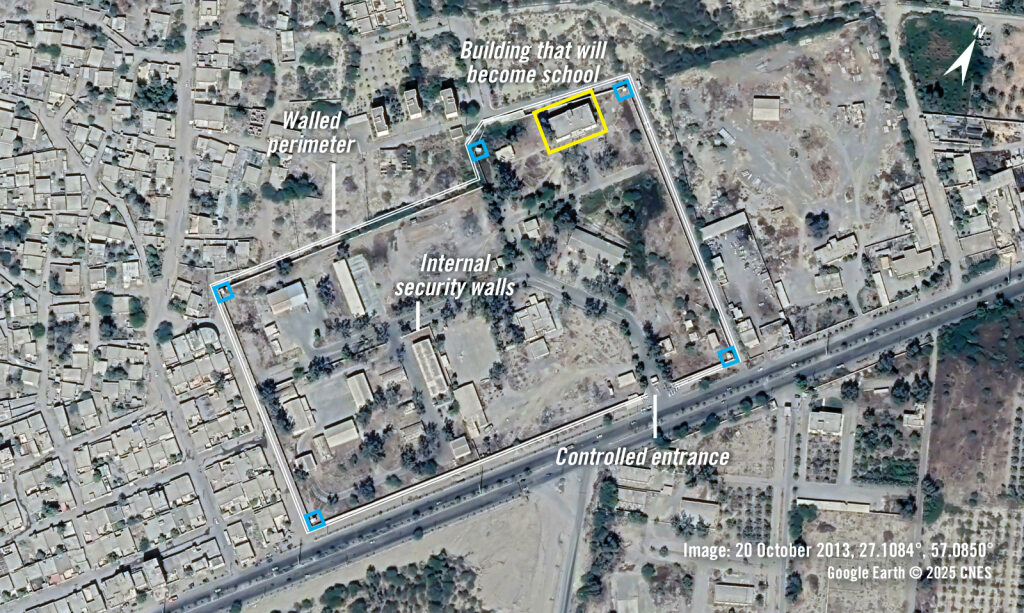
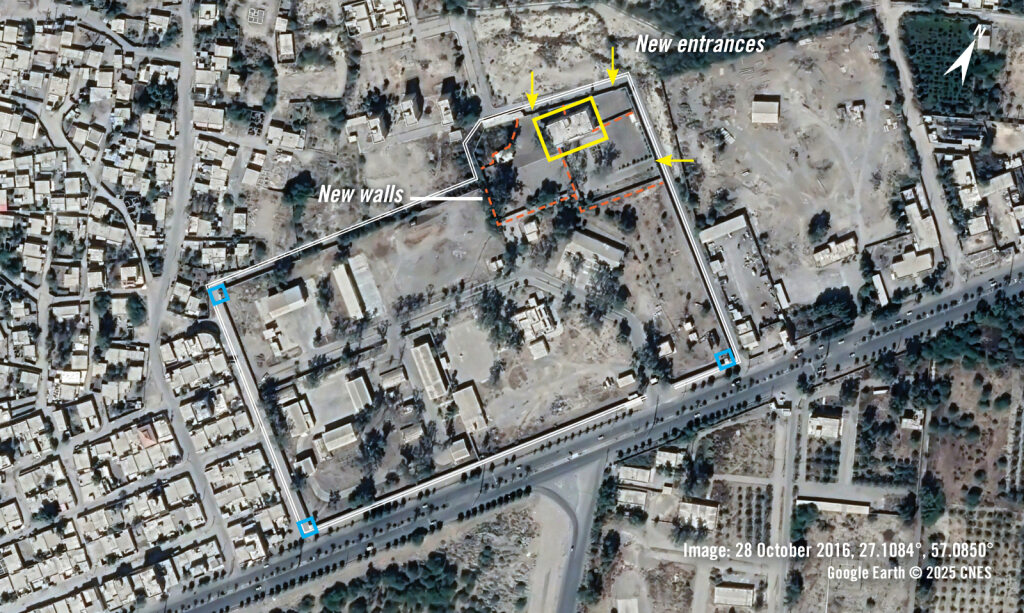
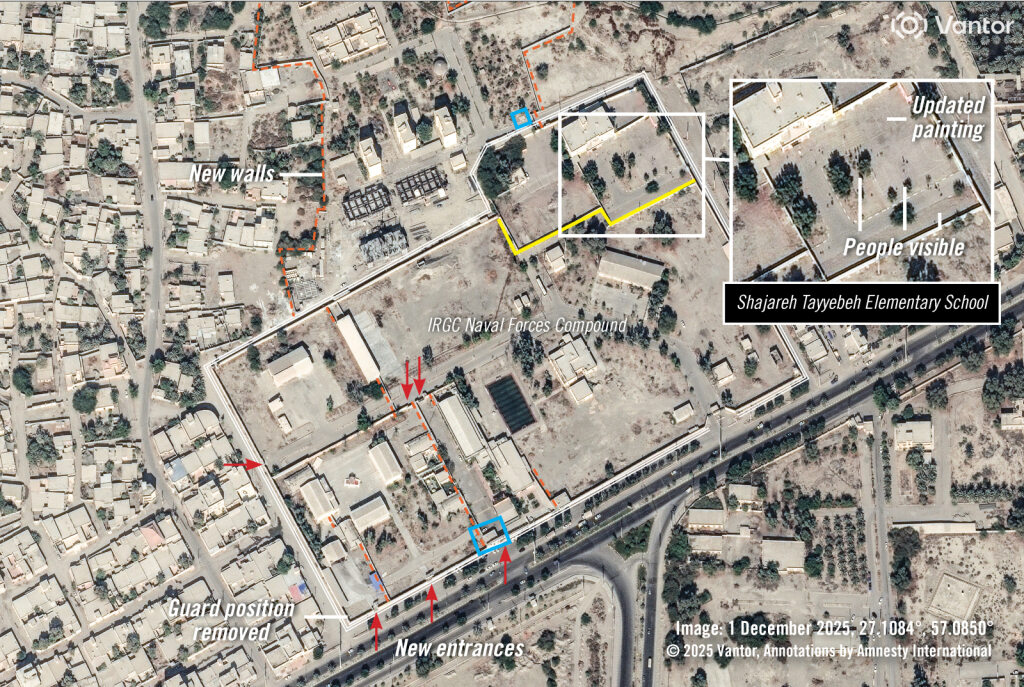
Amnesty International’s analysis of satellite imagery dating back to 2013 shows that the current school building was previously located within the perimeter of the IRGC compound but was later walled off and separate public entrances were created.
By 2016, satellite images indicate that the school premises, which were located in the northeast of the compound, had been physically separated from the IRGC compound through the construction of boundary walls and three separate gated entrances. Satellite imagery captured in 2017 and 2018 shows that the grounds and walls were painted with features and colours that look similar to other schools in the area. Between 2023 and 2025, two satellite images captured on school days show updated painting on the grounds and people present outside the entrances.
According to Shiva Amelirad, the school building previously served as the command headquarters of this IRGC compound before being converted into a school several years ago. Amnesty International has not been able to determine the date on which the building was converted into a school.
Satellite and video analysis of the strikes on the school and IRGC compound
Satellite imagery from 10.23am local time on 28 February 2026 indicates that the school and IRGC compound were still standing without visible damage at that time, suggesting that the strikes occurred sometime after.
Iranian state officials announced that the attack took place at 10.45am. Videos posted online at 11:49am and 12pm show thick smoke rising from the direction of the IRGC compound.
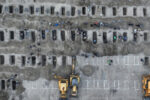
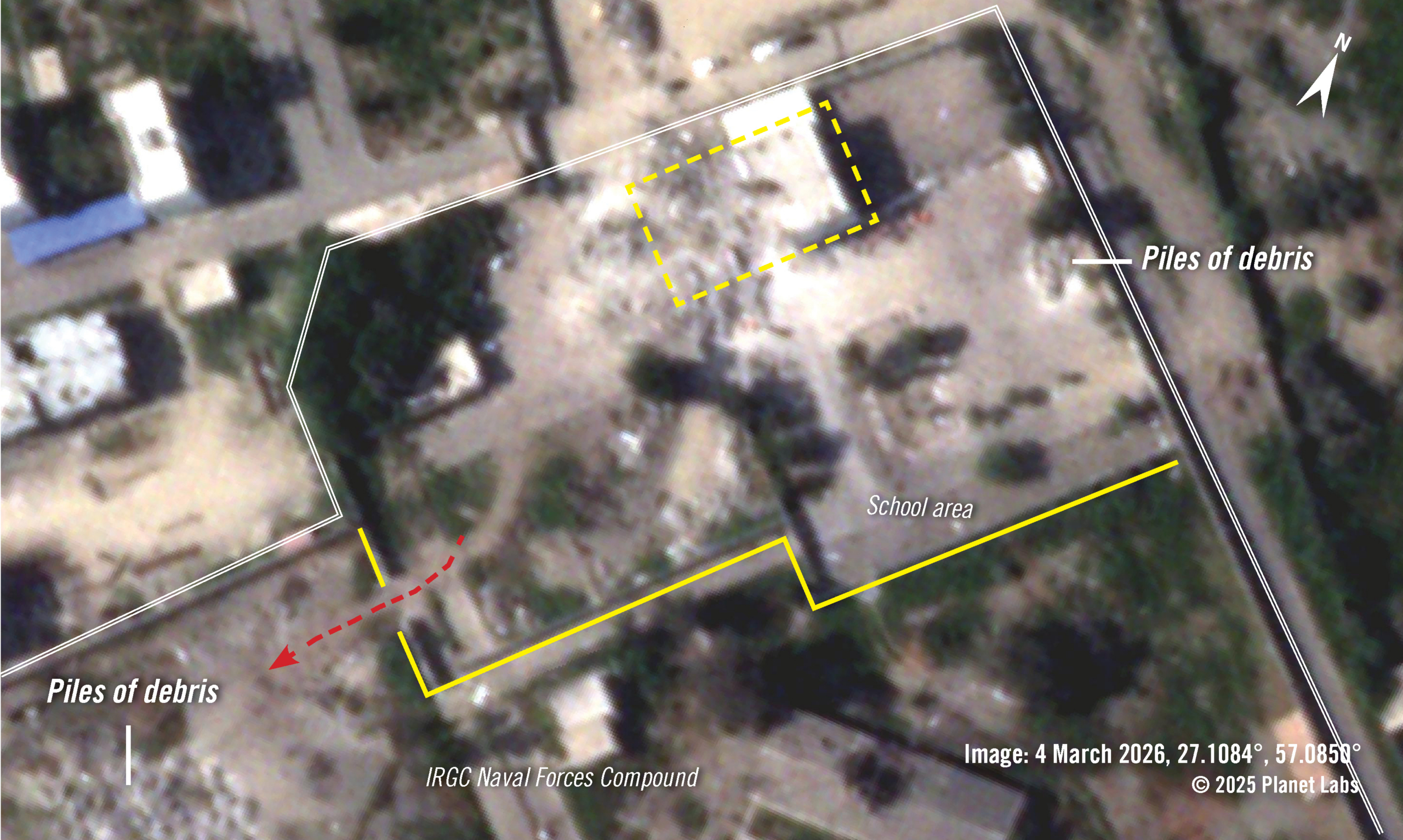
Analysis of satellite imagery on 2 and 4 March shows destruction at the site of the school and IRGC compound. The satellite imagery from 4 March 2026 shows the western half of the school building is destroyed with a large pile of rubble visible, as well as damage or destruction to at least 12 structures within the adjacent IRGC compound. The school building is around 74 metres from the nearest structure targeted in the adjacent IRGC compound.
Videos from the scene show distinctive pancaking of the roof, evidence of a top-down air strike, affecting much of the school building.
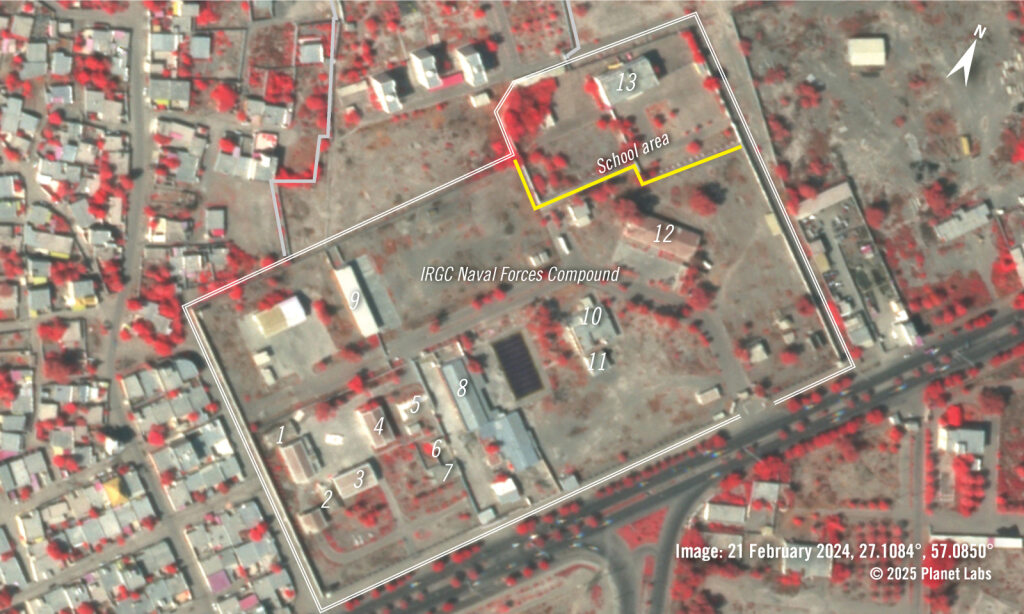
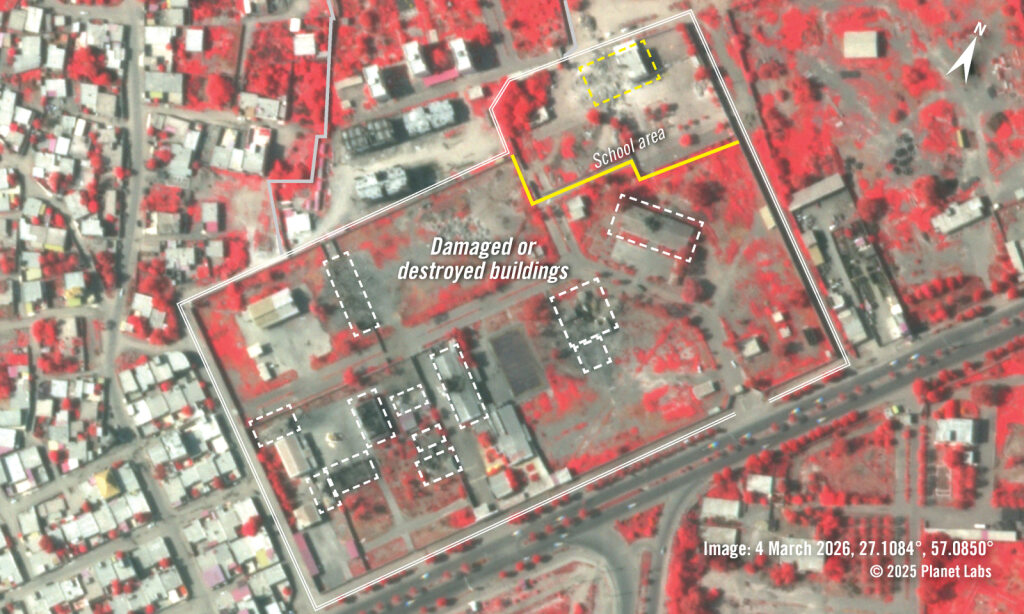
In addition to satellite imagery, multiple videos published on 28 February 2026 show the immediate aftermath of the strike on the school.
Video from the school grounds filmed after the strike shows the brightly painted walls separating the school from the IRGC compound and playground markings on the ground. On the western side of the school, the building appears largely collapsed into rubble. The eastern side, while still standing, is heavily damaged with thick smoke rising from inside.
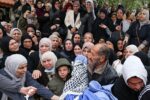
Videos and images published online show that the school yard quickly filled with scores of men and women following the strike, with some assisting in clearing rubble. Other videos show that the rescue efforts were supported by members of the Iranian Red Crescent Society and others, including men wearing green and brown camouflage uniforms resembling those of the IRGC and its Basij battalions, as well as several trucks and excavators.
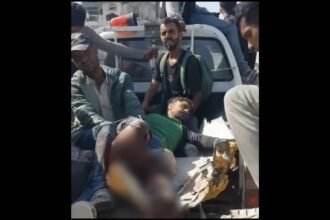
Several videos show dozens of dusty children’s backpacks collected in one area, some stained with what appears to be blood. In one video, women are seen sitting beside the backpacks and crying, while an excavator rumbles in the background. Another video captures several people standing around the rubble where part of a body is visible beneath the rubble. According to a forensic pathologist consulted by Amnesty International, the forearm appears to have been traumatically severed. The size of the hand and forearm, when compared with those of the adult males visible in the footage, indicates that they most likely belonged to a child. A video filmed later in the afternoon captures a man standing in the rubble and holding a severed hand and forearm. According to the forensic pathologist, the hand and forearm are covered in dust and lacerations consistent with trauma caused by an explosion and are also very likely from a child’s body.
A video filmed inside one of the classrooms shows rubble covering desks and benches. The window frames, green benches, and wall décor visible in the footage match the style of those elsewhere in the school, indicating that the destroyed part of the building was used for schooling.
A video published on 8 March 2026 by the state media Mehr News Agency in Iran and verified by Amnesty International shows the impact of a missile on the IRGC compound. Closer analysis of the footage indicates that the missile is very likely a US-manufactured Tomahawk subsonic cruise missile, identifiable by its distinctive wings and large squared fins. Based on the footage, this specific missile did not impact the school. The video also shows a plume of grey smoke from the northeastern part of the compound, which could originate from either the school or the adjacent buildings in the IRGC compound.
On 9 March 2026, state broadcaster, the Islamic Republic of Iran Broadcasting (IRIB), published images of what appear to be missile remnants consistent with a Tomahawk missile found. IRIB stated that the images pertain to “the remains of an American missile that landed on the children of Minab School”. While these remnants would further corroborate that parts of the compound were struck by at least one Tomahawk missile, Amnesty International is not in a position to independently verify whether the school was targeted by similar munition.
During a Pentagon press briefing on 2 March 2026, the US Chairman of the Joint Chiefs of Staff, Dan Caine, confirmed the US Navy had fired Tomahawk missiles on 28 February 2026 in southern Iran. During another press briefing on 4 March 2026, Dan Caine shared a map showing locations struck by US and Israeli forces during the first 100 hours of the military intervention that included Minab. When asked about the strike on the school, Secretary of Defence Pete Hegseth said the Pentagon was investigating the incident.
During a press briefing on 9 March 2026, in response to a question from a journalist about a Tomahawk missile likely striking the school, US President Donald Trump claimed that “Iran or somebody else” was responsible for the attack.
On 10 March 2026, a White House spokesperson confirmed that investigations into the school attack were ongoing, and that the US Department of Defence will release a full report.
International humanitarian law
International humanitarian law requires parties to the conflict to distinguish at all times between combatants and military objectives, on the one hand, and civilians and civilian objects, on the other hand. It is prohibited to directly attack civilians and civilian objects, such as schools. Only combatants and military objectives can be the object of attacks.
Parties to the conflict must also respect the principle of precaution, which requires them to take constant care to spare civilians and civilian objects during military operations, including by taking all feasible precautions to avoid or minimize incidental loss of civilian life, injury to civilians and damage to civilian objects during attacks.
This means they must do everything feasible to verify that targets are military objectives, including carrying out rigorous and up‑to‑date intelligence-gathering, as well as conducting analysis and verification of all available information concerning a target. They must cancel or suspend an attack if at any time during its planning or execution it becomes apparent that the target is not a military objective or that the attack would be disproportionate. Parties to the conflict must ensure that meaningful human control is maintained when using artificial intelligence during the planning and execution of attacks.
Parties to the conflict must also take all feasible precautions in choosing weapons, tactics and modalities of an attack, including its timing, with the aim to avoid or minimize incidental harm to civilians and damage to civilian objects, and they must give effective advance warning of attacks which may affect the civilian population, unless circumstances do not permit.
In addition, international humanitarian law requires parties to the conflict to take all feasible precautions to protect the civilian population and civilian objects under their control against the effects of attacks. This includes removing, to the extent feasible, civilians and civilian objects from the vicinity of military objectives. Accordingly, Iranian authorities should not have located the school in a building adjacent to an IRCG compound, which during armed conflict qualifies as a military objective and that was, in fact, targeted.
Authorities exploit child victims and coerce families for propaganda
Testimony and video evidence gathered by Amnesty International also reveals that Iranian authorities forced some bereaved children’s families to participate in funeral ceremonies that were not in accordance with their traditions and used traumatized child survivors for state propaganda.
Sohrab told the organization that the authorities informed families that all the children’s bodies would be placed in coffins and incorporated into a single, state-organized mass funeral on 3 March 2026 at which Shi’a Muslim prayers would be recited, despite the fact that some of the victims and their families were from Iran’s Sunni Baluchi minority who observe different religious rites. When some families expressed their wish to hold funerals in accordance with their own religious traditions, the authorities said this would not be permitted. According to Sohrab, officials told families that they would not receive their children’s remains until after the mass ceremony.
The authorities have also taken surviving children to the ruins of their school and filmed them for propaganda purposes, despite their visible injuries and trauma. In one video published online on 5 March 2026, a male journalist interviews two visibly distressed girls who appear to be aged between 7 and 11, repeatedly asking the younger child to name her friends who were killed and which ones she loved the most. The young girl names her friends and says that she loved all of them, adding that the mother of one of her friends who was a teacher was also killed, before breaking down into tears.
In another video, a 10-year-old girl with a visible facial injury was interviewed during the mass funeral ceremony about the killing of her 11-year-old brother, and the interview was subsequently broadcast on state media on 6 March 2026.
These acts of coercion, intimidation and instrumentalization of both grieving families and traumatised child survivors cause severe mental anguish and may violate the absolute prohibition of torture and other cruel, inhuman or degrading treatment.
US Congress should ensure ongoing efforts to mitigate civilian harm
Critical systems put in place in recent years building on work started under the first Trump Administration to reduce and better respond to civilian harm caused by US lethal actions abroad are under threat by the current Trump Administration. News outlets have reported that programmes at the Defence Department focused on civilian harm mitigation and response have been gutted, and that the US President has rolled back constraints on commanders authorizing certain types of air strikes and special operations. Defence Secretary Pete Hegseth has fired the top military lawyers responsible for ensuring compliance with international humanitarian law in military operations.
Background
On 28 February 2026, the US and Israel launched a joint military operation in Iran, with thousands of strikes across the country since. The Iranian authorities have launched retaliatory attacks across the region. The armed conflict rapidly expanded into regional hostilities across the Middle East and has resulted in significant loss of civilian life and destruction of civilian infrastructure. Israel has also escalated its attacks on Lebanon in response to Hezbollah’s attacks.
To date, according to reports at least 1,255 people have been killed in Iran; over 773 in Lebanon; at least 12 killed in Israel; and at least 17 killed across other countries in the region.
The head of the Information and Public Relations Centre at Iran’s Ministry of Education announced on 7 March 2026 that at least 66 schools across Iran have been damaged or destroyed, resulting in the deaths of students in several schools. In one incident, a schoolboy was killed on 28 February 2026 in the playground at Imam Reza Elementary School in Abyek, Qazvin province, following a nearby strike that shattered windows and sent debris across the yard. The incident was captured on CCTV.
In a 12 March statement, eight UN experts called for “independent investigation of specific attacks that could constitute grave violations of international humanitarian law” citing the targeting of the school.