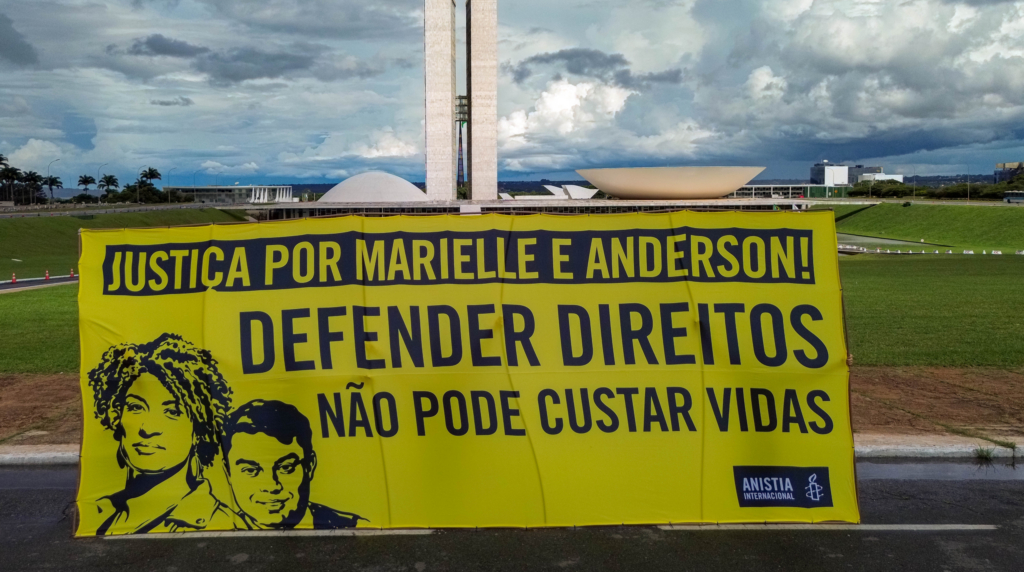
Brazil faces a decisive test of its willingness to confront impunity for attacks against human rights defenders in the coming weeks, said Amnesty International amid the beginning of the trials over the murders of Marielle Franco and Anderson Gomes, in the Federal Supreme Court, and Maria Bernadete Pacífico, known as Mãe Bernadete, in the Bahia Jury Court.
“Justice for Marielle Franco, Anderson Gomes and Mãe Bernadette is long overdue. Their killings are emblematic of the broader and highly alarming trend of lethal violence and structural racism against human rights defenders in Brazil,” said Agnès Callamard, Amnesty International’s Secretary General.
“These trials offer a historic opportunity to break the cycle of impunity that has characterized the state’s response to the killings of human rights defenders for decades. It is essential that they proceed with full independence, transparency and respect for due process. No one, regardless of their position or power, should be beyond the reach of the law.”
These trials offer a historic opportunity to break the cycle of impunity that has characterized the state’s response to the killings of human rights defenders for decades. It is essential that they proceed with full independence, transparency and respect for due process. No one, regardless of their position or power, should be beyond the reach of the law.”
Agnès Callamard, Amnesty International’s Secretary General.
Emblematic killings of defenders
Marielle Franco, a black, bisexual woman from the Maré favela, a human rights defender, and a Rio de Janeiro city councilor, was murdered on 14 March 2018, alongside her driver, Anderson Gomes. This crime, for which justice has not been delivered to this day, raises many questions about gender, race and class discrimination that need to be answered.
The trial before the First Panel of the Supreme Court, scheduled for 24 and 25 February 2026, will examine the responsibility of those accused of participating in planning and ordering the crime. It will be central to upholding the rights to truth, memory, justice, and reparation for the victims, their families and communities, and all those who continue to demand answers about who ordered Marielle’s murder and why.
Mãe Bernadete, a human rights defender and member of a quilombo community (Afro-Brazilian communities formed by descendants of formerly enslaved Africans who resisted slavery and established autonomous settlements) from Quilombo Pitanga dos Palmares, was killed in August 2023 in Salvador. She was killed amid a backdrop of structural racism, violence against quilombola communities, and conflicts over land and territory that have threatened the physical, cultural and spiritual survival of her people for years. The Bahia Court of Justice scheduled the jury trial of two defendants for 24 February 2026, almost two years after the crime, in a context of repeated threats, deaths of other family members, and attacks on terreiros (Afro-Brazilian religious temples) and Black leaders who denounce human rights violations and demand protection and effective public policies.
Delays expose structural impunity
The fact that it has taken eight years for this trial over the killing Marielle Franco and Anderson Gomes to take place will only take place in 2026 highlights how the Brazilian justice system fails to provide swift, effective, and respectful responses to victims and family members in cases of attacks on human rights defenders.
Years after the killings, family members, Black communities, quilombolas, peripheral communities, and religious communities continue to fight for memory, truth, and reparation, while facing insecurity, fear, institutional revictimization, and the feeling that the state still views their lives as disposable.
These two cases, although emblematic, represent only a fraction of a much broader picture of violence, threats, and persecution – often repeatedly denounced – that are not adequately investigated, do not result in accountability, and, in countless cases, do not even reach the stage of formal complaints being filed. The slow responses, failure to investigate those who order the attacks, the racial and territorial selectivity of the justice system, and the lack of consistent prevention and protection policies fuels the impunity that encourages new attacks and sends the message that it is possible to silence human rights defenders without facing the consequences.
Brazil is one of the deadliest countries for defenders
Several studies, surveys, and official statistics point to Brazil as one of the deadliest countries for human rights defenders, especially those seeking to protect the rights to land, territory, natural resources, and traditional peoples and communities. According to the organization Global Witness, 342 land and environmental defenders were killed in Brazil from 2012 to 2021, more than any other country on the planet during this period.
In agrarian and socio-environmental disputes, in urban areas marked by police violence, in quilombola and Indigenous territories, and in Afrodescendent religious spaces, defenders face threats, criminalization, murders, and disappearances, largely without the state taking adequate action to prevent, investigate, and punish these crimes.
The protection of human rights defenders remains inadequate due to insufficient public policies; limited protection programs; a lack of resources; profiling by police based on race, gender, class, and territory that remains largely unaddressed; and ineffective investigation of threats. Failure to respond firmly and swiftly to attacks and intimidation contributes to an environment of fear and self-censorship, in which many people give up reporting human rights violations, further aggravating the risks for those who remain on the frontlines.
“Defending rights should not cost lives. The Brazilian authorities must recognize the importance of human rights defenders and their actions, properly protect them and guarantee their rights, and ensure that any violations are exhaustively investigated and remedied, with fair and swift redress. The egregious killings of Marielle Franco and Mãe Bernadete must serve as a turning point in the protection of all those who dare to defend human rights in Brazil,” said Agnès Callamard.
Defending rights should not cost lives. The Brazilian authorities must recognize the importance of human rights defenders and their actions, properly protect them and guarantee their rights, and ensure that any violations are exhaustively investigated and remedied, with fair and swift redress.”
Agnès Callamard, Amnesty International’s Secretary General.
Amnesty International’s commitment to these and other defenders
Amnesty International has continuously campaigned for justice for Marielle, Anderson and Mãe Bernadete, denouncing violence against human rights defenders in Brazil at national, regional, and international levels, and urging the authorities to ensure independent, impartial, and effective investigations, with accountability for suspected perpetrators, including those who ordered the crimes. The organization has highlighted their stories in its reports, campaigns, and global mobilization actions, placing them at the center of the struggle for memory and reparation in the face of serious human rights violations committed against Black women, quilombola leaders, favela communities, and traditional peoples and communities.
At the same time, Amnesty International emphasizes that combating violence against human rights defenders in Brazil must not be limited to the search for justice for these killings. The organization will continue to demand answers for countless other cases that have not reached the trial stage, in which the perpetrators have not been identified, in which repeated threats have not been investigated, and in which families and communities remain without any form of reparation or official recognition.
Amnesty International will remain vigilant and continue to stand alongside the people and communities on the frontline of defending human rights in Brazil – in the favelas, lowlands, quilombos, indigenous lands, urban peripheries, terreiros, rural areas, and all territories marked by conflict, racism, and inequality. As the trials over the killings of Marielle, Anderson and Mãe Bernadete begin, the organization calls on Brazilian authorities at all levels to:
- Ensure fair, independent, and transparent trials, with effective protection for family members, witnesses, communities, human rights defenders, lawyers, prosecutors and others involved in the proceedings.
- Ensure that the masterminds, criminal networks, and economic and political networks and interests behind the crimes, are effectively investigated and held to account, without fear or favor: breaking with the practice of holding only the direct perpetrators accountable must be a priority.
- Strengthen, with resources, transparency, and social participation, policies and programs to protect human rights defenders, seriously and effectively ensuring a focus on race, gender, sexual orientation, territory, and class.
- Address structural impunity by reopening and reviewing closed or stalled cases, swiftly investigating reported threats, and adopting measures to prevent recurrence, including institutional reforms, training for public officials, and combating racism and institutional violence.
For more information or to request an interview, please contact: [email protected]