Iranian authorities are trampling upon children’s rights and committing a grave violation of international humanitarian law amounting to a war crime by recruiting and mobilizing children as young as 12 into a military campaign led by the Islamic Revolutionary Guard Corps (IRGC), Amnesty International said today.
On 26 March 2026, a deputy of the IRGC Mohammad Rasoul Allah Corps of Greater Tehran, Rahim Nadali, announced that a recruitment campaign called the “Homeland-Defending Combatants for Iran” is “open to volunteers” aged 12 and above, encouraging registrations at Basij bases in mosques across Tehran to join “combatants defending the homeland.” Eyewitness accounts and verified audiovisual evidence show child soldiers having been deployed at IRGC checkpoints and patrols, armed with weapons, including AK47pattern rifles.
“The Iranian authorities are shamelessly encouraging children as young as 12 to join an IRGC run military campaign, putting them in grave danger and violating international law, which prohibits the recruitment and use of children in the military. Recruiting children under 15 into the armed forces constitutes a war crime,” said Erika Guevara-Rosas, Senior Director for Research, Advocacy, Policy and Campaigns.
As US and Israeli strikes hit thousands of IRGC sites, including Basij facilities, across the country, including through drone attacks targeting security patrols and checkpoints, the deployment of child soldiers alongside IRGC personnel or in their facilities puts them at grave risk of death and injury.
Erika Guevara-Rosas, Senior Director for Research, Advocacy, Policy and Campaigns.
“As US and Israeli strikes hit thousands of IRGC sites, including Basij facilities, across the country, including through drone attacks targeting security patrols and checkpoints, the deployment of child soldiers alongside IRGC personnel or in their facilities puts them at grave risk of death and injury. Iranian authorities must immediately stop their criminal assault on children’s rights and prohibit the recruitment of anyone under 18 by the armed forces.”
According to official statements, under announced campaign, recruits are being assigned to a range of activities linked to the IRGC’s “operational and security” activities, including patrols, checkpoint duties, logistical support, distribution of equipment and supplies, and assisting with food, medical and relief tasks.
Amnesty International has analysed 16 photos and videos that have appeared online since 21 March 2026, showing children wielding weapons such as AK-pattern assault rifles or standing alongside IRGC and other forces at checkpoints, on patrols and during state-organized militarized rallies in Tehran, Mashad and Kermanshah.
On 29 March, 11-year-old boy, Alireza Jafari, was killed, while accompanying his father, a member of the IRGC’s Basij, at a checkpoint in Tehran, laying bare the devastating consequences of the presence of children at military objectives. Authorities have confirmed that the child was killed “while serving” at a checkpoint following an Israeli drone attack.
The boy’s mother told Hamshahri newspaper that on the night of the incident, her husband reported a “shortage of personnel” at checkpoints and took their sons, Alireza Jafari and his younger nine-year-old brother, with him. She added that her husband said Alireza “must get prepared for the days ahead” and that currently, children as young as 15 and 16 commonly take part in checkpoint duties.
A Senior Reporter for BBC Persian Forensic, Ghoncheh Habibiazad, shared with Amnesty International screenshots of text messages received from four eyewitnesses in Tehran, Karaj, and Rasht who reported seeing children deployed at Basijrun checkpoints and armed with weapons, including AK47pattern rifles, in March 2026.
One of the eyewitnesses from Tehran wrote:
“[On 25 March], I saw a child at a checkpoint near our house… I think he was about 15. He just had the faint beginnings of a moustache. It seemed like he was struggling to breathe from the effort of lifting the gun. He was pointing the gun toward the cars.”
Another eyewitness from Karaj wrote:
“Today [on 27 March], I saw a child at a checkpoint. I think he was about 16. His facial hair hadn’t even grown. He was holding a Kalashnikov rifle.”
An eyewitness from Rasht wrote on 30 March:
“I have seen children wielding weapons. They wear masks to cover their faces, but it is obvious they are kids. They have not even grown in height… some appear to be 13 years old at most… I saw [several] children standing in front of mosques [where Basij bases are located], ahead of the actual forces. I keep thinking their brains aren’t developed like adults and they might actually fire randomly. I am both scared of them and feel sad for them.”
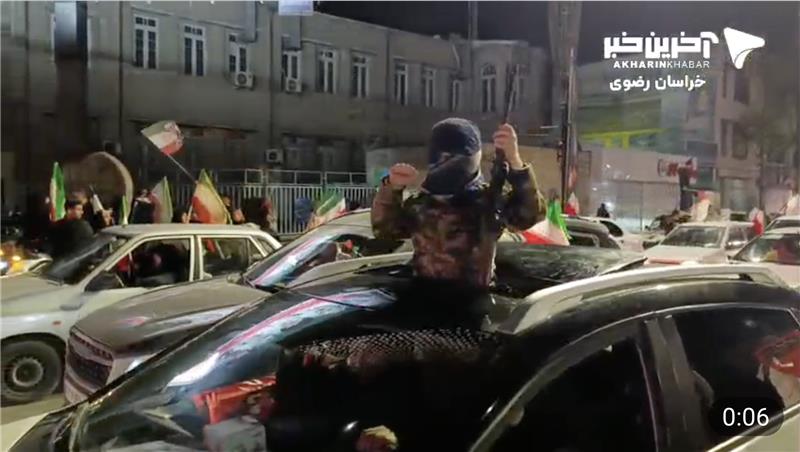
In a video posted online on 30 March 2026, filmed in Mashhad at Shariati Square, two children, visibly identifiable from their height and stature, are seen wearing Basij camouflage uniforms and balaclavas and carrying AK‑pattern assault rifles while positioned on a white car during a state-organized rally. One child is visible standing through a side window, while the other appears positioned through the top window of the vehicle. The footage shows the children elevated above the crowd as the car moves through the square, with people around them cheering and waving flags.
The recruitment announcement was circulated alongside a poster depicting a man in a uniform belonging to the Basij battalions of the IRGC, a woman in civilian dress, and two children, a boy and a girl. The poster promoted the campaign under the slogan “Basij with people, for people,” and featured a quote from the late Supreme Leader and commander-in-chief of the armed forces Ali Khamenei, stating that “Basijis must remain at the heart of the field for the main virtues of the Revolution to stay alive.”
In an interview aired by state media, a deputy of the IRGC Mohammad Rasoul Allah Corps of Greater Tehran, Rahim Nadali, spoke of the “high enthusiasm” among teenagers to join “intelligence and operational patrols,” saying:
“Teenagers and youth have repeatedly come forward saying they want to take part… Given the ages of those making these requests, we have set the minimum age at 12. There are now kids aged 12-13 who want to be present in this space.”
Abusive legislative framework enabling the enlistment of children
The latest recruitment of children is enabled by the IRGC Recruitment Regulations Law, which divides the IRGC personnel into two categories: official guards and Basijis. Article 13 defines Basijis as ordinary, active, and special Basijis. Ordinary Basijis are described as individuals “from various segments of society who believe in the Constitution of the Islamic Republic of Iran and the goals of the Islamic Revolution”. After completing general training, they join and are organized within the “20-million-strong army”, a term coined by the first Supreme Leader, Rouhollah Khomeini, shortly after the 1979 Revolution, and during the Iran-Iraq War (1980-1988) became known as a reference to state efforts at mass mobilization of children and youth into military campaigns.
Article 93 explicitly allows children under 15 to become ordinary Basijis, effectively setting no minimum age.
Active Basijis are ordinary Basijis who “volunteer to be organized” and can “collaborate with the IRGC in carrying out assigned missions” after completing training. Article 94 allows children aged 15 and above to qualify as active Basijis.
Special Basijis, also described as “honorary guards”, are those who “possess the qualifications of an [official] guard and, after completing the training stipulated in this law, are organized and commit to being available fulltime to the IRGC when needed.” Article 16 allows children as young as 16 to become special Basijis.
Although authorities frequently describe Basijis as “popular forces” or “the people’s forces” of the IRGC, in reality these units are not voluntary. Basij members receive financial compensation. Various laws and policies also require the government to provide Basij agents with preferential access to employment opportunities, housing facilities and loans, and admission advantages for higher education institutions, all of which heighten the risk of recruitment of children from impoverished communities, particularly in a context marked by severe economic hardship.
Iranian authorities must immediately issue explicit instructions to prohibit military forces in Iran, including the Basij structures of the IRGC, from enlisting children under 18 and ensure that existing Basijis and other members of the armed forces who are under the age of 18 years are immediately released from service..
Iran is a party to the the Convention on the Rights of the Child, which prohibits recruitment of children under 15. The Optional Protocol to the Convention, which Iran has signed but not ratified, prohibits the compulsory recruitment by states of children under-18, as well as the use of under 18s in hostilities. Under customary international humanitarian law, which is legally binding on Iran, conscripting or enlisting children under the age of 15 into the armed forces or groups, or using them to participate actively in hostilities constitutes a war crime.
Background
According to Iranian authorities, Israeli-USA strikes have killed more than 1,900 people, including 249 women and 216 children. In one egregious incident, a USA strike on a school in Minab killed 168 people, including more than 100 children. Amnesty International’s investigation into the attack found that the school was directly hit with precision-guided munitions and that USA forces failed to do everything feasible to verify that the intended target was a military objective.
Attacks by the Islamic Republic of Iran have killed at least 16 in Israel, four in the West Bank and 23 in Gulf Cooperation Council (GCC) states.
The Iranian authorities have a record of violating international humanitarian law by recruiting children, particularly during the 1980s when, by their own admission, over 550,000 children were sent as child soldiers to the Iran–Iraq war, and at least 36,000 of them were killed.