Austrian authorities’ responses to people expressing solidarity with Palestinians during Israel’s ongoing genocide against Palestinians in Gaza have resulted in a chilling effect on the right to freedom of expression, said Amnesty International in a new report. Their actions have also resulted in violations of the rights of freedom of expression and peaceful assembly.
‘Freedom of expression is highly selective’: Austria limits expressions of solidarity with Palestinians identifies multiple factors – including undue restrictions on expression, and fear caused by broad allegations of antisemitism against the backdrop of racism, including Islamophobia – that have combined to negatively impact the freedom of expression in Austria for Palestinian solidarity among activists, NGOs, academic institutions and beyond.
In Austria, as in other parts of Europe, there is a risk that antisemitism is being instrumentalized and politicized
Shoura Hashemi, Executive Director of Amnesty International Austria
“A significant chilling effect has taken hold and has seriously impacted people’s ability and willingness to express solidarity with the Palestinian people or criticize the actions of the Israeli government in Gaza,” said Shoura Hashemi, Executive Director of Amnesty International Austria.
“In Austria, as in other parts of Europe, there is a risk that antisemitism is being instrumentalized and politicized. Equating criticism of the Israeli state with antisemitism can result in violations of freedom of expression and shrinking space for critical civil society, and also undermines efforts to combat genuine antisemitism.”
The report, which included 19 interviews with activists, journalists, NGO representatives and academics, noted how many of these individuals and civil society organizations risked being branded “antisemitic” when they criticized Israel’s violations of international law.
While anti-Muslim racism has been a long-standing concern in Austria, governmental sources and civil society organizations report that, after October 2023, racist incidents have increased across the country, particularly anti-Palestinian racism. An Austrian-Palestinian person described the shift after October 2023, saying: “There was a huge change with 7 October [2023]…I always have a sense that I have to justify myself when someone talks to me.” Despite recommendations by UN experts, Austria has not established a national action plan to combat racism, including anti-Muslim racism.
Crackdown on protest
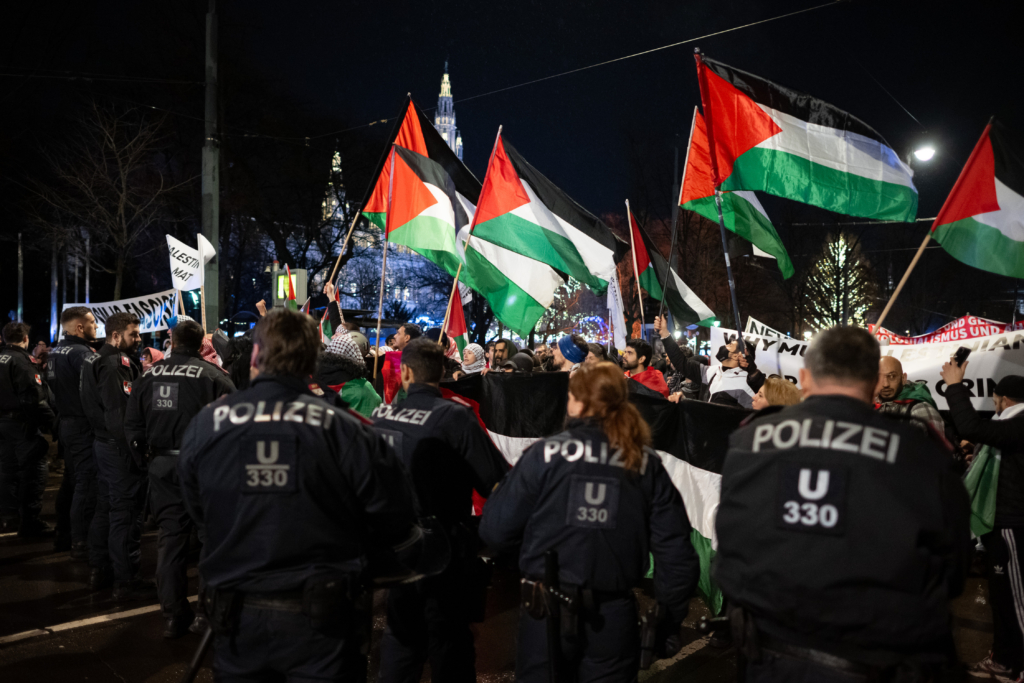
Since the start of Israel’s ongoing genocide against Palestinians in Gaza, people in Austria who peacefully protested against the genocide have faced multiple challenges and serious restrictions on their rights to freedom of expression and peaceful assembly.
For instance, the authorities have imposed unlawful restrictions on the right to peaceful assembly in connection with the widely used chant ‘From the river to the sea, Palestine will be free’, and police authorities prohibited at least seven assemblies in Vienna on the grounds that this chant was likely to be used. Furthermore, the chant is subject to a non-public decree issued by the Ministry of Justice. According to the ministry, use of the chant is enough to warrant an initial suspicion of “approval of terrorist offences” and anyone using it could be liable for investigation. Although the chant is used by different groups and has various meanings, the National Strategy against Antisemitism equates the chant with the call to deny the existence of the State of Israel.
Under international human rights law, any restrictions on the rights to freedom of expression and peaceful assembly must comply with certain criteria, including be provided in a law that is accessible to the public and sufficiently clear and precise. Prohibitions of speech also require demonstrating that it reaches a high threshold and constitutes incitement to discrimination, hostility or violence against a target group.
Over several years, there have been a number of non-binding resolutions passed by the Austrian National Council, as well as the city councils of Vienna and Graz, against the Boycott, Divestment and Sanctions (BDS) movement, some of which have labelled it as antisemitic. However, the European Court of Human Rights has found that a call for a boycott is protected under the right to freedom of expression.
Although not legally binding, these resolutions are supported by all political parties in parliament and are widely interpreted as authoritative guidance. By labelling BDS antisemitic, the resolutions have negatively impacted the right to freedom of expression, as activists and civil society organizations told Amnesty International that they fear court proceedings, smear campaigns or loss of state funding if they express their support for the BDS movement.
The instrumentalization of the IHRA working definition of antisemitism
The International Holocaust Remembrance Alliance Working Definition of Antisemitism (IHRA WDA) is not consistent with international human rights law and has been used to restrict legitimate criticism of Israeli government violations of Palestinians’ rights.
The IHRA WDA has been criticised by UN experts, academics and civil society groups, including Amnesty International, for not being consistent with international human rights law. Amongst other concerns, reliance on the IHRA WDA conflates legitimate criticism of Israel with antisemitism. This risks creating a chilling effect and suppressing freedom of expression and peaceful assembly. There is a danger that it also limits Austria’s policies and efforts to combat antisemitism within the country.
Although the definition is not legally binding in Austria, it has a significant influence on policy and practice. It is, for example, the applicable understanding of antisemitism in several governmental documents, including policies to address antisemitism in the country.
Seven of the people interviewed by Amnesty International, including Jewish activists, explicitly identified Austria’s adoption of the IHRA WDA as part of the reason why expressions of solidarity with Palestinians were limited.
“The fight against antisemitism is essential and must be in line with international human rights law. Only then can there be a shared understanding of the problem, its causes, and effective measures to eliminate it. If not, we risk replacing discrimination against one group with discrimination against another, and fuelling hatred instead of addressing it,” said Shoura Hashemi.
Shrinking space for expression of solidarity with Palestinians
The report highlights a shrinking space for expression of solidarity with Palestinians among civil society organizations and academics. Two civil society organizations told Amnesty International that they feared losing state funding if they spoke out against human rights violations committed by Israeli authorities against Palestinians. There have also been several cases of politicians publicly questioning the eligibility of NGOs for state funding as a result of positions that they have taken.
Equating criticism of the Israeli state with antisemitism can result in violations of freedom of expression
Shoura Hashemi
“Austrian authorities must adopt a national action plan against racism and end the dissemination of the IHRA WDA through policies and practices. The decree regulating the ‘From the river to the sea’ chant must be repealed and any restrictions on the right to freedom of expression must comply with international human rights law. Austrian authorities must respect and protect the right to advocate for BDS as legitimate forms of political expression,” said Shoura Hashemi.
Background
In April 2023, Amnesty International was one of more than 100 organizations calling on the United Nations not to endorse or adopt the IHRA WDA.