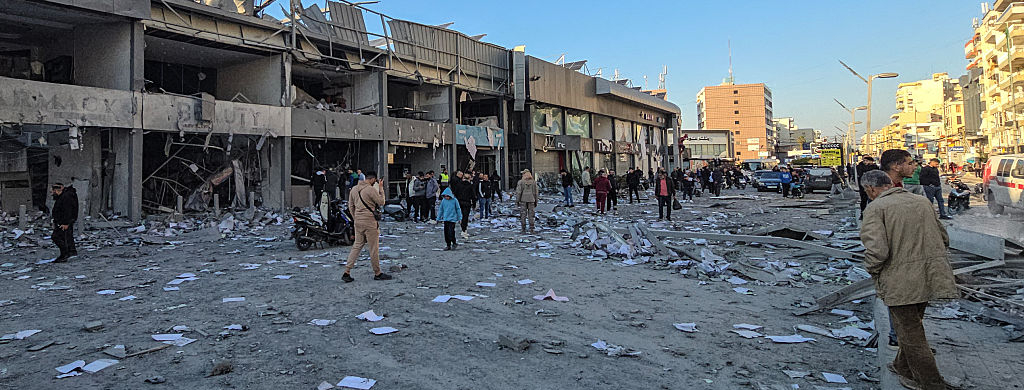
Israeli air strikes on locations linked to al-Qard al-Hassan, a non-profit financial institution associated with Hezbollah, must be investigated as war crimes as they do not constitute legitimate military targets under international humanitarian law, Amnesty International said today.
Since 2 March, the Israeli military has announced that it would target all branches of al-Qard al-Hassan across Lebanon and by 10 March said that it had struck “around 30 branches” during the past week. Many al-Qard al-Hassan offices are located within residential buildings or in crowded neighbourhoods. The attacks across Beirut’s southern suburbs, south Lebanon and the Beqaa, have destroyed facilities used by tens of thousands of civilians to access financial services, including loans to pay for school fees, healthcare expenses and vehicles to commute to work.
“Over and over again, the Israeli military has appeared to assume that labelling something as Hezbollah-affiliated, be that healthcare workers, homes in border villages, or financial institutions, makes it targetable. That’s wrong,” said Heba Morayef, Regional Director for the Middle East and North Africa at Amnesty International.
“Allegations of financial links do not, on their own, turn a civilian or a civilian building into a military objective. Distinguishing between military objectives and civilian objects is a cornerstone of international humanitarian law. Hezbollah is both a military and a political actor, but it also runs service and charity institutions staffed by civilians.”
“Civilians and civilian objects do not become lawful targets simply because of an affiliation or perceived connection. Yet once again, Israel is destroying branches of a financial institution that serves as a lifeline for thousands of people in desperate need. These attacks are unlawful and must be investigated as war crimes.”
Amnesty International reviewed the Israeli military’s claims about the attacks, verified footage of four locations targeted on 2 and 9 March, and interviewed 12 people from diverse backgrounds who had used al-Qard al-Hassan’s financial services. Pseudonyms are used throughout to protect people’s privacy and security.
Striking civilian infrastructure under vague ‘terrorist’ claims
Al-Qard al-Hassan Association has long been one of the country’s main microcredit providers, operating under an NGO license issued by the Lebanese government since 1987. It does not have a license from the Central Bank of Lebanon to operate as a financial institution. Since 2007, the association has been under US sanctions based on its links with Hezbollah. In July 2025, the Central Bank instructed licensed financial institutions to halt all dealings with entities not licensed by the Bank and subject to foreign sanctions, including al-Qard al-Hassan.
Under international humanitarian law, civilian objects, which include financial institutions, are protected. Only military objectives may be lawfully targeted. These are strictly limited to objects that both make an effective contribution to military action and whose destruction, capture or neutralization, in the circumstances ruling at the time, offers a definite military advantage.
Amnesty International has not seen any evidence from Israeli authorities showing that the branches of this financial institution meet these criteria.
Civilians and civilian objects do not become lawful targets simply because of an affiliation or perceived connection.
Heba Morayef, Amnesty International
In its communications announcing the attacks, the Israeli military did not claim the offices were currently being used to directly contribute to military action. On 2 March, the Israeli army’s Arabic-language spokesperson wrote on X that al-Qard al-Hassan “uses civilian deposits to provide financial services to Hezbollah and its operatives for terrorist purposes”. On 9 March, the spokesperson described the association as “terrorist infrastructure” and “a central element in financing Hezbollah’s terrorist activities [that] harms the Lebanese economy in service of Iranian interests.”
Even if the Israeli authorities’ allegations that Hezbollah used al-Qard al-Hassan for financial services were true, this would not strip these buildings of their protected status under international humanitarian law.
“States should make clear that it is unlawful to launch attacks against financial institutions. Financial support or affiliation are not sufficient grounds for such targeting. And these attacks are particularly troubling because they are having devastating consequences for civilian infrastructure and livelihoods,” said Heba Morayef.
This is the third round of Israeli military attacks on al‑Qard al‑Hassan. During the 2024 escalation, on 21 October, the Israeli military claimed to target “close to 30” of its sites across Beirut and its southern suburbs, South Lebanon, and the Beqaa. At the time, Amnesty International called for the attacks to be investigated as war crimes.
In December 2024, after a ceasefire was declared, the association announced the reopening of 16 branches across Lebanon. After the most recent round of attacks, some structures remained standing but were no longer operational.
“For more than two years, the Israeli military has been carrying out egregious unlawful acts in Lebanon with impunity, including multiple rounds of attacks on civilian objects. States with influence over Israel should act to ensure accountability, so we can end this devastating cycle of violations,” said Heba Morayef.
Multiple attacks, with and without warnings
Israel’s attacks on the branches of al-Qard al-Hassan were carried out in two major rounds on 2 and 9 March.
On 2 March 2026, at approximately 1:55pm, an Israeli military spokesperson announced that Israeli forces were beginning “attacks on infrastructure belonging to Hezbollah’s al-Qard al-Hassan” and ordered residents within a 300‑meter radius of 18 identified locations to evacuate immediately. Between 1:55pm and 2:30pm, the spokesperson released a series of maps identifying each of the targeted locations across Lebanon, followed by a composite image showing all 18 sites.
Individual evacuation warnings were issued for Borj al-Barajneh in Beirut’s southern suburbs; for three locations in Labweh, Ain Bourday, and Housh al-Ghanam in the Baalbeck region; and for additional locations in Bednayel and Hermel. Additional posts followed, issuing warnings for sites in Tyre/Sour, Mashghara, Deir Qanun al-Nahr; then for sites in Bint Jbeil, Qana, Maaroub, Nabatieh al-Tahta; and finally for sites in Deir al-Zahrani, al-Sultaniya, Toul, and Habboush.
I took loans to cover my children’s school fees and repaid about $50 a month. When new expenses came, I would finish one loan and take another, like many families did to secure their children’s education costs.
“Umm Ali”,55, who relied on al‑Qard al‑Hassan for over 27 years
A few minutes before 4pm on the same day, Israeli forces began striking these locations. At 7:38pm, the spokesperson announced the end of the operation and stated that the strikes were carried out because of al-Qard al-Hassan’s financial activities in support of Hezbollah.
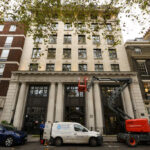
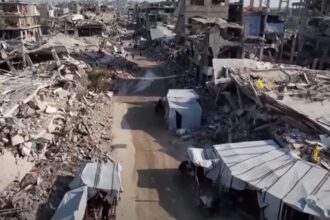
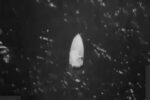
Footage verified by Amnesty International’s Evidence Lab shows the moment when an air-dropped munition fell on a three-storey building in a residential and commercial area in Tyre/Sour on 2 March. Videos of the aftermath show the destroyed building stood in front of a shopping mall where several businesses suffered extensive damage, including a department store, restaurants and a pharmacy.
Less than 2km away, an 11-storey building housing another branch of al-Qard al-Hassan was also destroyed. Footage verified by the organization shows a pile of rubble and damage to apartment buildings nearby. The destroyed building stood across the street from an elementary school.
Since issuing a mass‑evacuation order to four major districts of Beirut’s southern suburbs on 5 March – reiterated repeatedly, including on the same day and on 7 March – Israeli forces have repeatedly struck multiple areas of Beirut’s southern suburbs, day and night, without issuing specific warnings.
One week later, on 9 March at 8:49am, an Israeli military spokesperson announced further strikes on al‑Qard al‑Hassan branches, this time specifically warning about strikes in Beirut’s southern suburbs. Unlike the detailed 2 March warnings, the 9 March message referred only to “the terrorist infrastructure of al-Qard al-Hassan Association” in Beirut’s southern suburbs, without identifying individual locations or providing a map.
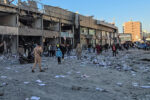
Two hours after the more general 9 March warning, at 10.50 a.m., Israeli forces launched another wave of air strikes on the southern suburbs targeting more than a dozen buildings, including buildings that hosted al-Qard al-Hassan.
In Lebanon, many people have long used institutions outside the formal banking system, including al-Qard al-Hassan, for a variety of financial services. Following the 2019 financial and economic collapse, banks in Lebanon repeatedly refused to grant people full access to their savings, or simply closed their doors.
“Umm Ali”, 55, told Amnesty International that she relied on al‑Qard al‑Hassan for over 27 years: “I took loans to cover my children’s school fees and repaid about $50 a month. When new expenses came, I would finish one loan and take another, like many families did to secure their children’s education costs.”
“Mayyada”, a woman in her fifties, said she has been using al‑Qard al‑Hassan for more than eight years. Her daughter told Amnesty International “My brother also placed his wife’s gold as collateral at al‑Qard al‑Hassan. There is a lot of bad talk about al-Qard now because of the political situation, but we have never lost anything with them, unlike with the banks.”
“Nouhad”, 61, said she borrowed a necklace from her cousin and pawned it at al-Qard al‑Hassan in 2023 in order to buy a motor for her sewing‑machine, which was her household’s only source of income: “Without this money, I would not have been able to earn a living, because I could never have afforded the US$250 motor on my own. In my area there are almost no work opportunities, especially for older people.”
People outside the Shia community have also used al-Qard al-Hassan’s services. “Maria”, 29, from a middle‑class Christian area, used them for the first time in 2023. She placed three broken gold chains at al-Qard al‑Hassan and took a small loan: “We used to assume we couldn’t benefit from al-Qard al‑Hassan. I only realised later that this option was open to everyone.”
Similarly, a 61‑year‑old man from Saidon/Saida told Amnesty International that he “only recently discovered” that he could access al‑Qard al‑Hassan’s services, “despite being Sunni.” He added that he preferred using al‑Qard al‑Hassan because its loans are interest‑free (interest is prohibited in Islam).
Background
On 2 March 2026, Hezbollah launched a series of attacks into Israel in response to the killing of Iranian Supreme Leader Ali Khamenei following a US-Israeli attack on Iran. The Israeli army then announced on X that its forces were striking Hezbollah targets across Lebanon as part of Operation “Roar of the Lion.” In the following days, Israel carried out hundreds of strikes across the country and issued a series of mass evacuation orders.
Hezbollah has continued to launch rockets into Israel on a daily basis. In 2024, Amnesty International found that Hezbollah had repeatedly used inherently inaccurate weapons in their attacks on Israel.
Sine 28 February 2026, Amnesty International’s monitoring of Israeli media and Telegram channels indicates that at least 12 civilian casualties have been reported in Israel as a result of attacks from Iran.
As of 11 March, Lebanon’s Disaster Management Unit reported 634 people killed, including children, with 816,700 displaced.