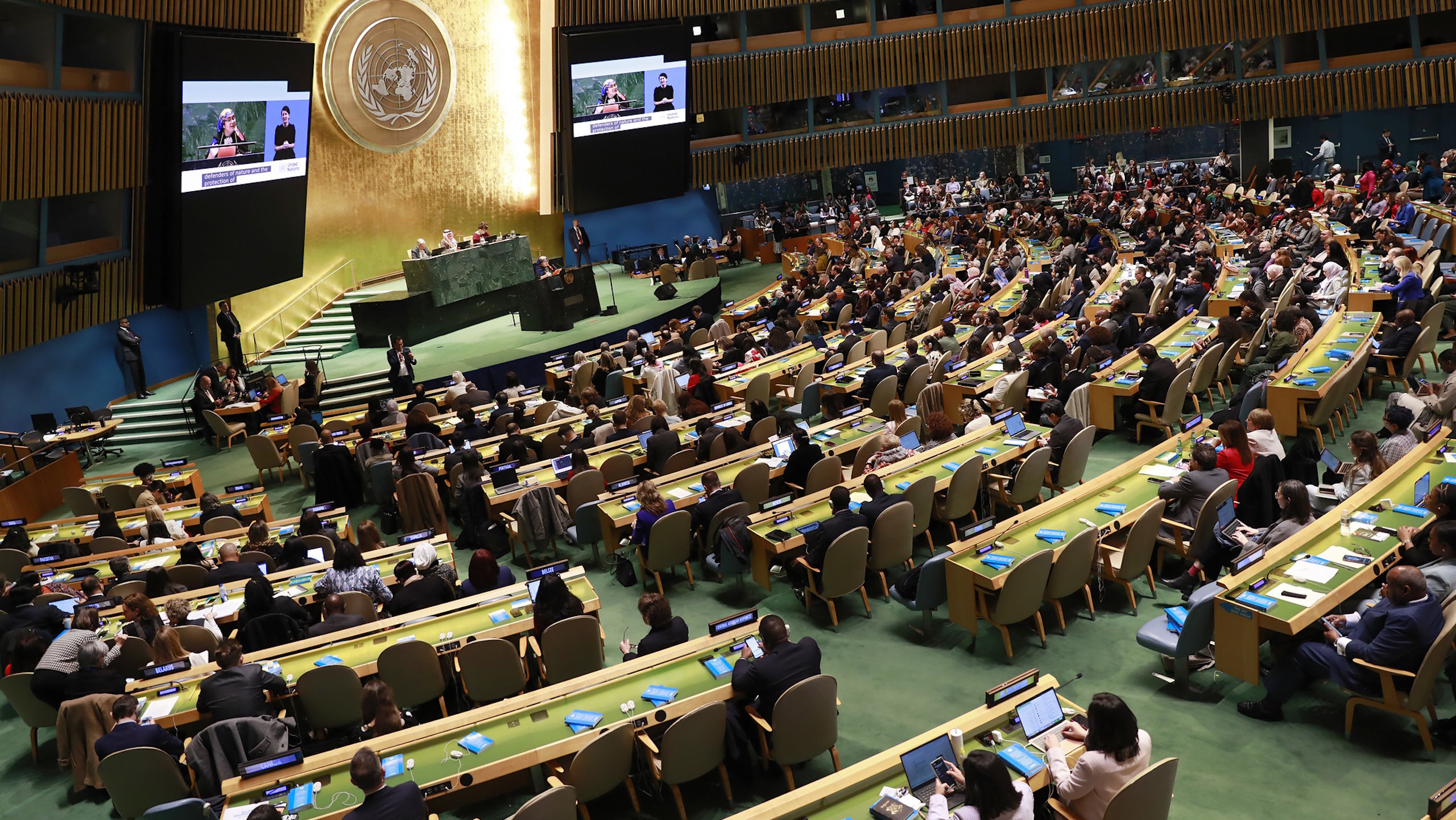
At the opening of its session, the UN Commission on the Status of Women (CSW) adopted its Agreed Conclusions on strengthening access to justice for all women and girls, following weeks of intense pressure from a small, but vocal group of states seeking to derail the negotiations and the adoption of the text.
The Commission adopted the Agreed Conclusions through a vote after the United States blocked adoption by consensus. An overwhelming majority of states supported the final text, with 37 out of the 45 member states of the Commission voting in favor, 6 abstaining, and only the US voting against.
Civil society and grassroots movements played a decisive role in securing this outcome. Feminist organizations and activists closely monitored negotiations, coordinated advocacy across capitals, and mobilized governments for months.
“At a time of severe backlash on human rights and multilateralism, the adoption of Agreed Conclusions that safeguard long-standing gender equality standards is a powerful signal that global commitments still matter and that attempts to turn back the clock will not go unchallenged,” said Agnès Callamard, Amnesty International’s Secretary General.
“From the frontlines of communities to the halls of the UN, feminist groups and women human rights defenders continue to resist the backlash against gender justice, while mobilizing states to ensure that hard-won gains are protected and vigorously defended.”
This is the first time in the history of CSW that an outcome isn’t adopted by consensus, demonstrating both the deepening polarization around multilateral negotiations and the determination of an overwhelming majority of states to protect long-standing gender justice norms.
From the frontlines of communities to the halls of the UN, feminist groups and women human rights defenders continue to resist the backlash against gender justice, while mobilizing states to ensure that hard-won gains are protected and vigorously defended.
Agnès Callamard, Amnesty International’s Secretary General
Over a period of several weeks, UN member states engaged in negotiations on draft Agreed Conclusions focused on this year’s CSW priority theme: “Ensuring and strengthening access to justice for all women and girls”.
During the negotiations, the US and several other states, including Argentina, Russia and Saudi Arabia, sought to water down or reopen language drawn verbatim from previous CSW agreements. A broad group of states pushed back, repeatedly reminding those delegations that reopening agreed language would undermine years of established commitments. Ultimately, the Chair of CSW and the co-facilitators tabled a text that made some concessions while safeguarding core elements of previously agreed language.
Even as the Commission convened to adopt the outcome, efforts to derail the process continued. In a last-minute procedural move, the US presented amendments, arguing that the text still included “controversial” and “ideological” issues. The amendments decisively failed, with only the US voting in support of them. At the same time, other states — including Egypt and Nigeria — repeatedly called for a delay to the vote to allow more time for negotiations, despite extensive consultations and efforts by the co-facilitators to produce a balanced text while respecting integrity of agreed language.
“While the loss of consensus is disappointing, a weakened text – or no outcome at all – would have sent an especially troubling signal to women and girls who continue to face barriers to access to justice, and multiple and intersecting forms of discrimination. In a climate marked by widespread impunity, Amnesty reiterates its calls on states to step up resistance to attacks on gender justice,” said Agnès Callamard.