Prior to the upcoming session of the United Nations Committee on Enforced Disappearances to be held in Geneva, Switzerland, and which from 10 to 12 March will assess the progress and challenges faced by Ecuador in preventing, investigating and punishing enforced disappearances, Amnesty International has stated that these crimes remain unpunished and will continue to happen as long as President Daniel Noboa’s security policy remains militarized.
“This is a crucial opportunity to inform the international community that the armed forces have committed enforced disappearances under the Noboa administration, and that the victims’ families continue to demand truth, justice and reparation. Now more than ever, we must heed their demands,” said Ana Piquer, Americas director at Amnesty International.
This is a crucial opportunity to inform the international community that the armed forces have committed enforced disappearances under the Noboa administration, and that the victims’ families continue to demand truth, justice and reparation.”
Ana Piquer, Americas director at Amnesty International.
The organization submitted information to the Committee based on its report “It was the military, I saw them: Enforced disappearances in Ecuador at the hands of the armed forces”, which documents the disappearance of ten people in five security operations carried out in 2024 in the context of the militarized security strategy driven by President Noboa.
Recent progress
On 22 December 2025, a court issued a landmark ruling sentencing eleven military officers to 34 years and eight months in prison following the enforced disappearance of four Afro-descendant teenagers from the “Las Malvinas” community in Guayaquil. Five others received reduced sentences of 30 months in prison after collaborating with the investigation, while a lieutenant colonel prosecuted as an accomplice was acquitted. The sentence also ordered reparation measures, including a public apology and a memorial ceremony at the Taura Air Base. The ruling was officially published on 24 February 2026 and was immediately appealed by two of the convicted officers.
A Constitutional Court ruling that could serve to strengthen the comprehensive reparation framework for victims and their families is still pending.
“This ruling represents a crucial step towards truth, justice and reparation for victims and their families. However, it continues to be urgent that all allegations of enforced disappearance trigger a search and a criminal investigation. Full cooperation from the armed forces is essential for this,” said Ana Piquer, Americas director at Amnesty International.
However, it continues to be urgent that all allegations of enforced disappearance trigger a search and a criminal investigation. Full cooperation from the armed forces is essential for this,”
Ana Piquer, Americas director at Amnesty International.
As a result of national and international pressure, in January 2026 the Public Prosecutor’s Office added a new prosecutor to the specialized unit for investigating the illegitimate use of force, which is in charge of investigations into enforced disappearances. As of December 2025, this unit had only seven prosecutors to cover the entire country, and only one in the coastal region, where the highest number of reports of enforced disappearances are concentrated, including the more than 20 cases for which the Committee has issued urgent actions. While the appointment of a new prosecutor is a positive development, the measure remains insufficient to ensure prompt and thorough investigations.
Persisting concerns and new risks
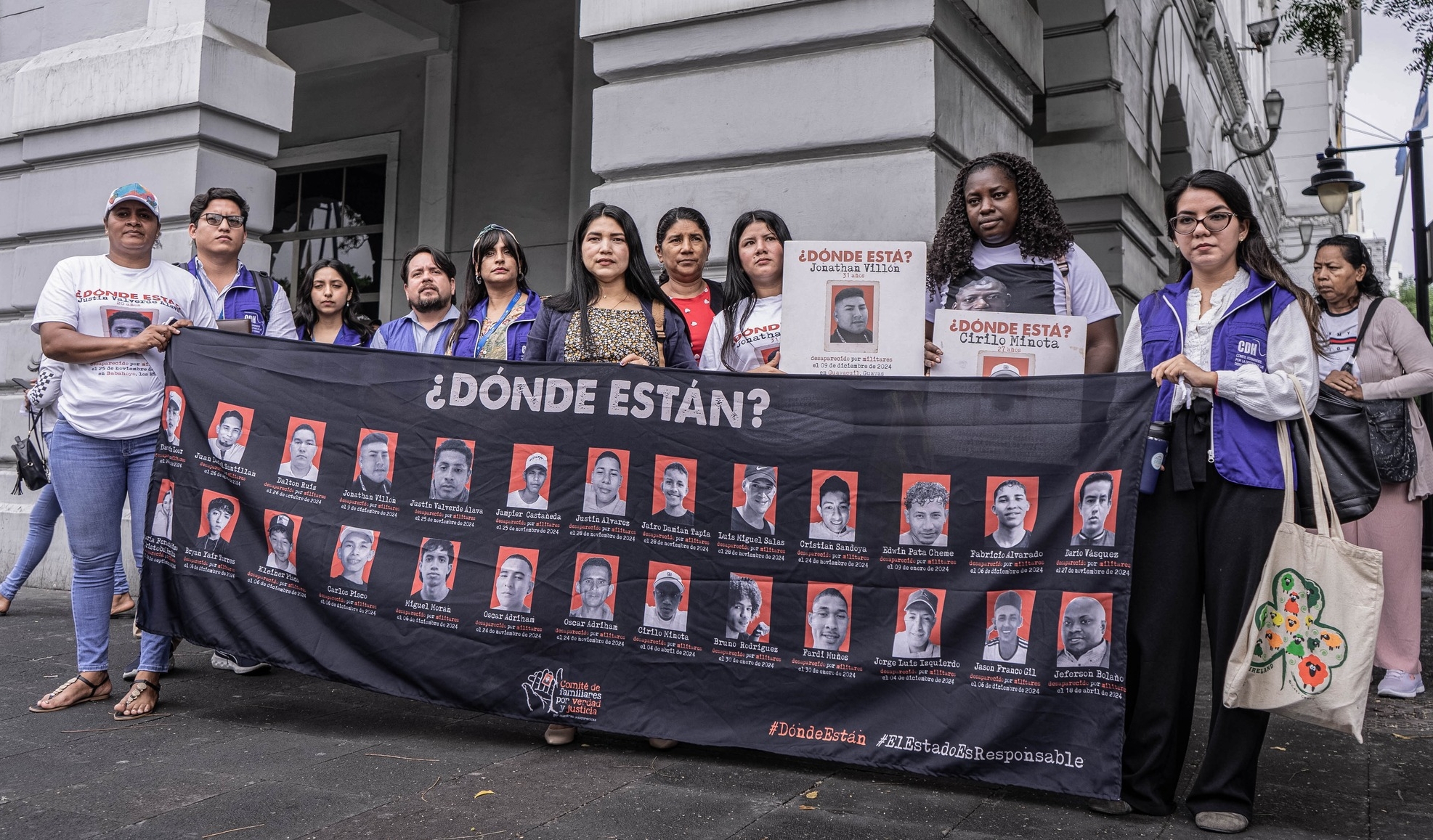
On 24 December 2025, the Inter-American Commission on Human Rights (IACHR) granted precautionary measures in favour of 26 disappeared persons and six women searching for them, on grounds that they face a serious and irreparable risk in the context of the militarized security strategy.
Despite these measures, the risks against searchers in Ecuador persist. According to the Permanent Committee for the Defence of Human Rights (CDH Guayaquil), on 22 January 2026 members of the armed forces allegedly entered the home of relatives of Óscar Arturo Adrihan Bravo and Jonathan Gabriel Adrihan Bravo, to harass and intimidate them. Óscar and Jonathan are among the beneficiaries of the IACHR’s recent precautionary measures because of their disappearance.
On the following day, 23 January, an interinstitutional roundtable was set up in the province of Guayas to follow up on the IACHR measures, with the participation of several ministries and human rights organizations. However, according to the Guayaquil Human Rights Council, the Ministry of Defence did not attend, despite the fact that most reports involve military personnel.
On 2 March, the Ecuadorian authorities announced a joint operation to fight organized crime. According to a communication from the US Embassy, the Ecuadorian armed forces, the US Southern Command and EUROPOL participated in the operation. This announcement raises deep concern given the documented evidence of serious human rights violations, including enforced disappearances, and lack of transparency that have characterized execution of security operations under the so-called Phoenix Plan.
Urgent calls
Given the limited progress and the numerous pending measures to ensure truth, justice and reparation for all victims of enforced disappearances in Ecuador, Amnesty International urges the Ecuadorian authorities to:
- Conduct prompt, impartial and effective investigations aimed at determining the whereabouts of the disappeared persons and identifying those responsible for their disappearance so they can be brought to justice.
- Ensure the participation and protection of victims’ families.
- Guarantee the full and good faith cooperation of the armed forces in legal proceedings.
- Guarantee protection and the right to search for relatives of victims of disappearance.
- Reverse the militarized approach to public security that has facilitated serious human rights violations.
- Promptly sign and ratify without reservation The Ljubljana-Hague Convention on International Cooperation in the Investigation and Prosecution of the Crime of Genocide, Crimes against Humanity, War Crimes and Other International Crimes.
In addition, the organization calls on the authorities of countries involved in law enforcement operations in Ecuador to ensure that any assistance provided complies fully with international human rights obligations and is subject to effective accountability mechanisms.
For further information or to arrange an interview, please contact [email protected]