The new Criminal Regulation recently endorsed by the Taliban leader will further entrench violence and discrimination against women, Amnesty International said in a new legal analysis documenting its wide-ranging and regressive impact on human rights.
The “Criminal Procedure Regulation of the Courts”, which lays out punishments and sentencing for a range of vague and overly broad offences, criminalizes domestic violence only in cases where a woman has suffered a broken bone or visible injuries. The decree also prescribes a three-month prison sentence for any woman who regularly visits family members without her husband’s permission and who refuses a court order to return home.
The regulation also prescribes harsh punishments for religious non-compliance, more severe punishments for people of lower social status and recognizes slavery. Other provisions authorize the destruction of property as a form of punishment, institutionalize torture and other ill-treatment through corporal punishment, and sanction the death penalty for a greater number of offences.
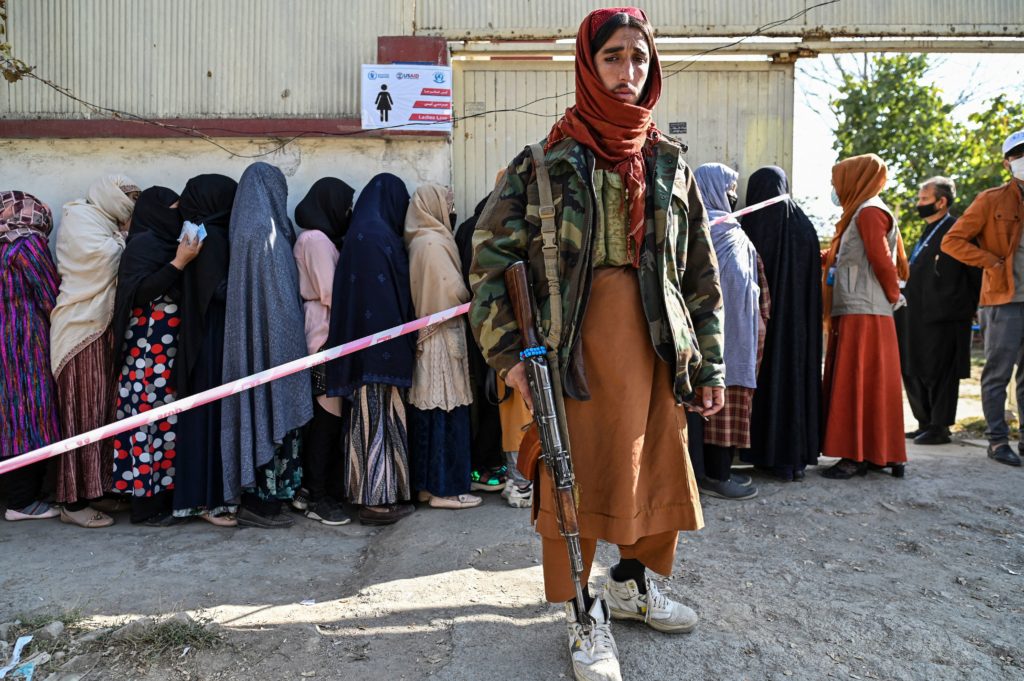
“The regulation makes an already repressive legal system even more draconian. Women and girls are, of course, among the most affected, with provisions that normalize domestic violence and place even greater restrictions on their movement and autonomy,” said Smriti Singh, Amnesty International’s South Asia Director.
The regulation makes an already repressive legal system even more draconian
Smriti Singh, Amnesty International’s South Asia Director
“Provisions on strict religious observance and the scaling of punishment depending on social class will entrench discrimination and target the country’s most marginalized and economically disadvantaged people.”
“We call on the Taliban to immediately revoke or revise this repressive regulation and bring it in conformity with international human rights standards. We also urge the international community to unequivocally condemn the regulation, and pressure the Taliban to end their ongoing widespread and systematic violations of human rights.”
The analysis highlights some of the central draconian provisions of the regulation and the challenges they pose, as well as how they will impact human rights in at least seven areas. The areas, and some of the key issues covered, are highlighted below:
Women’s Rights: How the changes outlined above remove essential safety mechanisms for victims and survivors of gender-based violence.
Freedom of Religion, Belief, Thought, and Expression: The impact on religious minorities of severe new penalties for deviating from the Hanifi School of Sunni Islam that the Taliban claim to adhere to, and the designation of beliefs contrary to the Sunni Branch of Islam as heretical.
Torture and other Ill-treatment: How the regulation provisions prescribe torture and other ill-treatment in the form of flagging or lashing for a wide range of offences.
Death Penalty: The prescription of the death penalty for a broad range of offences including ‘habitual sodomy’ based on a discretionary judgement from an Imam that it is in the ‘public interest’.
International Fair Trial Standards: How vague definitions of offences empower the Taliban judges and authorities to arbitrarily define and implement them, which will further undermine the justice process.
Equality Before the Law: The division of offenders into four categories with a sliding scale of punishments based on social hierarchy.
Slavery: How the wording of some provisions appears to recognize ownership over certain individuals, and expressly recognize slavery
Background
On 5 January, the Taliban leader endorsed the regulation and ordered its publication in the Official Gazette, where laws and other legislative documents are published to ensure public awareness and accessibility. On 8 January, the Taliban’s Supreme Court Secretariat (Dar -al-Insha,), circulated the regulation to the members of the Supreme Court, directorates, and courts for its implementation. Though the regulation is not yet published in the official Gazette, the Taliban stated on 23 January that it would be published soon. Amnesty International contacted the de facto Taliban authorities on 19 February seeking an official copy of the regulation and any accompanying materials for this analysis, and to determine whether the regulation has been effectively enforced, but no response was provided.
On 15 February, a media outlet reported that the implementation of the regulation had led to the prosecution of an individual in Badghis province for insulting the Taliban leader.