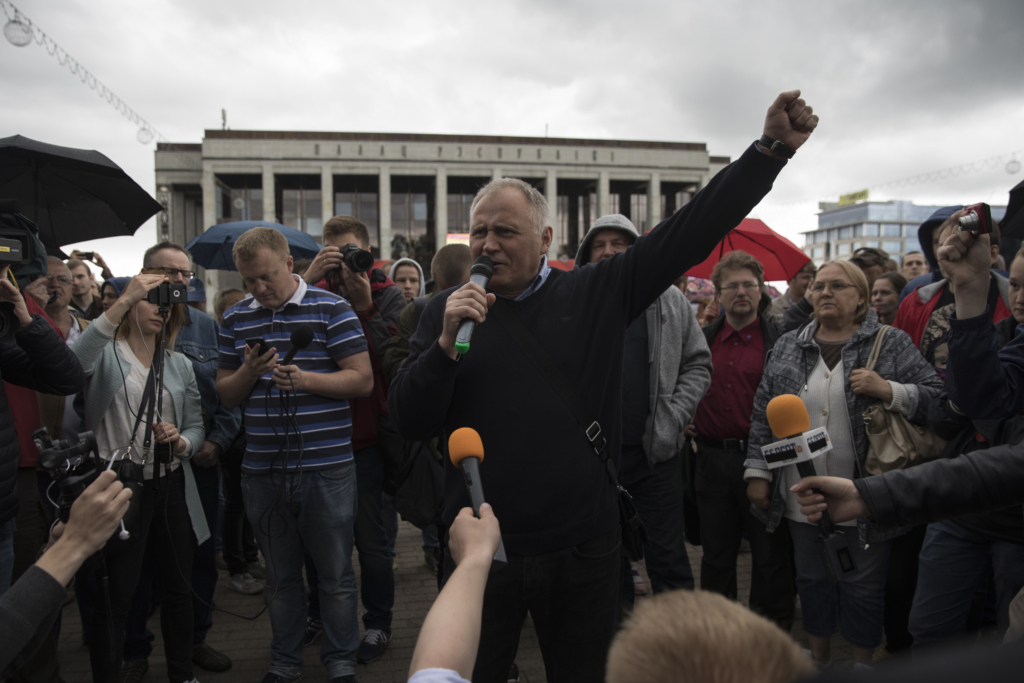
Responding to the release of the Belarusian opposition politician Mikalai Statkevich, detained since 2020, Marie Struthers, Amnesty International’s Eastern Europe and Central Asia Director, said:
“Our relief at Mikalai Statkevich’s release is tempered by our indignation at the profound injustice and personal injury he has suffered during years behind bars serving an unfounded prison sentence, much of it in prolonged isolation. The latter is in violation of the absolute prohibition of torture and other ill-treatment — his health severely deteriorated. Releasing a prisoner of conscience after he has suffered a stroke is not justice, it is the sign of its profound absence.
Our relief at Mikalai Statkevich’s release is tempered by our indignation at the profound injustice and personal injury he has suffered during years behind bars serving an unfounded prison sentence, much of it in prolonged isolation
Marie Struthers, Amnesty International’s Eastern Europe and Central Asia Director
“Belarusian authorities must end the practice of imprisoning of activists, journalists and other government critics for peacefully exercising their rights to freedom of expression, association and assembly. The authorities must immediately and unconditionally release all persons unjustly detained and imprisoned on politically motivated charges, including prominent human rights defenders Nasta Loika, Marfa Rabkova, Valiantsin Stefanovich and Vital Chopik.
“The Belarusian authorities have committed egregious violations. They must fully comply with their international human rights obligations, and those responsible for violating them must be held to account.”
Background
On 19 February 2026, Mikalai Statkevich’s wife, Marina Adamovich, confirmed that her husband had been released from a high security penal colony after suffering a stroke and spending several weeks in a prison hospital.
Mikalai Statkevich, 69, a long-time government critic, prominent opposition leader and former presidential candidate, was arrested on 31 May 2020. He was later sentenced to 14 years’ imprisonment on trumped up charges of “organization of mass unrest” (Article 293(1) of the Criminal Code).
On 11 September 2025 he was released as part of a political deal between Belarus and the US. However, unlike other released prisoners, he refused to be forcibly exiled from Belarus and was forcibly disappeared at the border, and secretly returned to a penal colony where he was held incommunicado thereafter. During his latest imprisonment starting in 2020, he was held in isolation for long periods of time, reportedly contracted COVID-19 multiple times and on 21 January 2026 suffered a stroke.
As of 20 February 2026, the Belarusian Human Rights Centre Viasna claims 1,144 individuals as political prisoners in Belarus. Its list however is not exhaustive and is based on publicly available information which the Belarusian authorities are seeking to restrict.