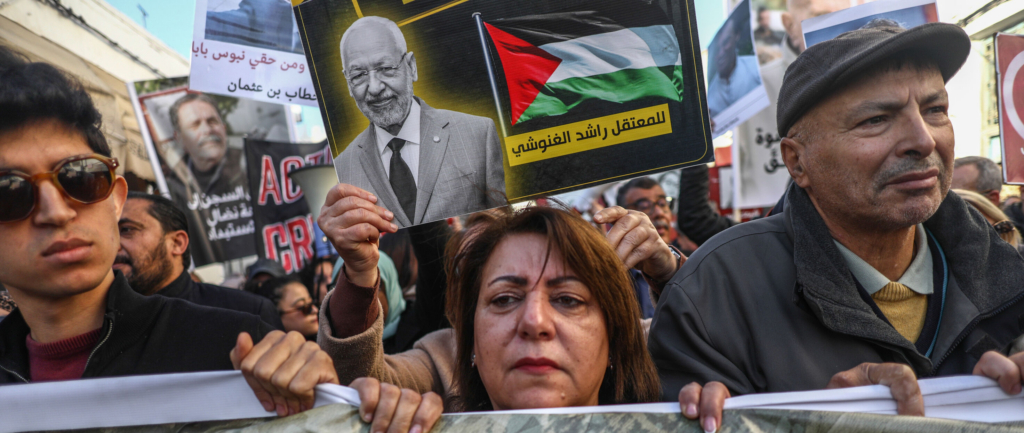
The heavy prison sentences imposed on Rached Ghannouchi and four other Ennahda party leaders mark is the latest blow in the Tunisian authorities’ campaign to crush the opposition party ousted from power by President Kais Said in 2021 as part of their broader crackdown on dissent, Amnesty International said today.
On 2 February, a Tunis appeals court convicted at least 20 individuals including opposition figures handing down prison sentences ranging from three to 35 years in the case known as “Conspiracy against State Security 2”.
The prison term for Rached Ghanouchi, the 84-year-old former Ennahda leader detained on various charges since April 2023, was increased from 14 to 20 years bringing the total prison terms issued against him in multiple cases to 56 years. The court also upheld 35-year sentences in absentia against former intelligence chief Kamel Guizani, former foreign minister Rafik Abdessalem, Lotfi Zitoun and Mouadh Ghannouchi, Rached Ghannouchi’s son.
Tunisian authorities should immediately quash the unjust convictions and sentences of all defendants. Authorities must respect and ensure the human rights of everyone and uphold the rule of law in the country.
Sara Hashash, Deputy Regional Director for the Middle East and North Africa at Amnesty International.
“Tunisian authorities should immediately quash the unjust convictions and sentences of all defendants. Authorities must respect and ensure the human rights of everyone and uphold the rule of law in the country.”
“The multiple persecutions of the members of Ennnahda show how Tunisa’s justice system is being instrumentalized by the authorities to crush all forms of political opposition and silence peaceful dissent. In Tunisia today, the majority of opposition leaders from different political backgrounds/groups/affiliation are already behind bars. The latest Conspiracy 2 case verdict sends a chilling message: peaceful opposition of the authorities is now punished with decade-long prison sentences,” said Sara Hashash, Deputy Regional Director for the Middle East and North Africa at Amnesty International.
“In recent years the human rights situation in Tunisia has sharply deteriorated, with authorities escalating their repression against the political opposition, carrying out a systematic purge targeting the Ennahdha party. This travesty of justice and attack on the rule of law must end.”
Since the dissolution of the Tunisian parliament in March 2022, in which the Ennahda party held a strong majority, leaders, former members of parliament, staff and members of the Ennahdha party have been systematically targeted. Its leaders, volunteers, and grassroots members have faced judicial harassment, arrest, detention and prosecutions in relation to terrorism-related accusations or alleged conspiracies against state security, often without credible evidence. At least 26 Ennahdha party leaders, employees and members are currently detained and being investigated or prosecuted. Many others have left the country.
The First Instance trial in the Conspiracy 2 case had concluded on 8 July 2025 with mass conviction of 21 out of 24 individuals including senior political leaders from Ennahdha Party like Habib Ellouz, Lotfi Zitoun, former members of parliament, former government and security officials. Sentences ranged from 12 to 35 years. The trial was marred by fair trial violations with defendants held in pre-trial detention compelled to participate in hearings remotely via video link from prison, a measure that according to their lawyers hampered their ability to communicate with legal counsel and engage effectively with the court.
The Ennahda leaders stand accused of running a covert network led by Ghannouchi aimed at “changing the structure of the state” with the help of former Ministry of Interior official Kamel Ben El Bedoui. The charges were based on allegations of “conspiracy against state security”, largely relying on anonymous witness testimony, intercepted communications, and documents seized during police raids.
Much of the material consisted of political criticism and private communications critical of President Saied dating back to between 2011 and 2022, but with no concrete evidence of a recognizable offense under international law. The authorities’ central claim that certain opposition politicians operated a clandestine “security apparatus” remains unsubstantiated by any independently verifiable evidence.
Systematic targeting of Ennahda
In recent years Tunisian authorities have increasingly turned to counterterrorism laws and state security charges to arbitrarily prosecute and detain opposition figures including leading figures amongst the Ennahdha Party leadership. Courts have conducted mass trials based on insufficient evidence or unfounded accusations, resulting in repeated violations of fair trial guarantees.
In addition to his most recent sentence in the Conspiracy 2 case, Rached Ghannouchi had already been sentenced in multiple other cases. Since his arrest in April 2023, he has been investigated or prosecuted in at least 11 different cases. In May 2023, Tunisia’s anti-terrorism court sentenced him to a year in prison and a fine in connection with public remarks at a funeral in which he praised the deceased as a “courageous man” who did not fear “a ruler or tyrant”.
In April 2023, shortly after Rached Ghannouchi’s arrest, security forces shut down all offices of the Ennahda party across the country.
Mondher Ouinissi who replaced Rached Ghannouchi as head of the party was also arrested and detained a few months later on 7 September 2023 and is being prosecuted in a separate case for conspiracy charges. Ajmi Ouirimi who followed as Secretary General of the party, was also arrested and detained since July 2024.
Even members and supporters of Ennahda have been targeted. In September 2024, security forces arrested at least 97 people for their activism within Ennahda party groups in different regions, as part of a pre-electoral crackdown ahead of the presidential elections. Most of them were released over the following weeks.