The Department for Work and Pensions (DWP) has quietly shut down its sole inbox that disabled people can use to lodge a complaint about discrimination within the government’s Access to Work scheme.
It comes amid broader largely clandestine moves to restrict eligibility to support under the scheme. Notably, Labour DWP minister Stephen Timms has now admitted to signing off on a series of non-policy changes to the operation of the scheme. And crucially, these amount to nothing less than a programme of de facto backdoor cuts.
The sudden closure of this key complaints route now raises more concerns about Labour’s plans for the scheme.
Access to Work complaints procedure… no longer accessible
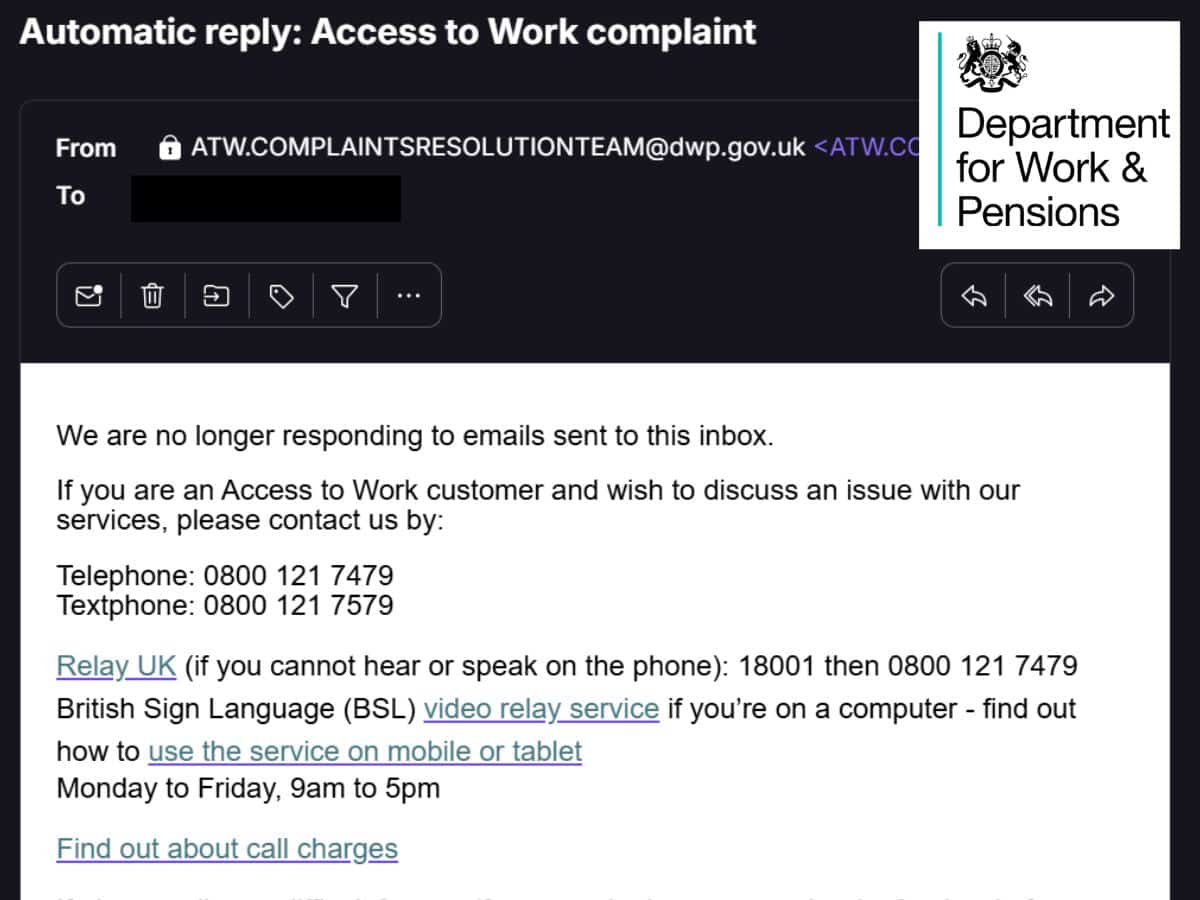
At the start of October, disabled people and those supporting Access to Work clients noticed that the DWP’s main complaints email was bouncing back with the message:
We are no longer responding to emails sent to this inbox.
If you are an Access to Work customer and wish to discuss an issue with our services, please contact us by:
Telephone: 0800 121 7479
Textphone: 0800 121 7579Relay UK (if you cannot hear or speak on the phone): 18001 then 0800 121 7479
British Sign Language (BSL) video relay service if you’re on a computer – find out how to use the service on mobile or tablet
Monday to Friday, 9am to 5pmFind out about call charges
If phone calls are difficult for you (for example, because you’re deaf or hard of hearing), you can ask for all communication to be by email instead.
Essentially, the email – formerly [email protected] – was one avenue of the DWP’s official Access to Work complaints procedure. With the department no longer monitoring the inbox, disabled people can now only make complaints about the service via the DWP’s Access to Work telephone line, or by letter.
Unlike other DWP services, Access to Work does not have a reconsideration or appeals process. However, as its website explains, the complaints procedure does not provide a route to challenge an award decision in and of itself:
Not agreeing with the level of your award and the results of reconsideration does not, on its own, give reasons for a complaint.
However, if case managers administering these decisions have gaslit, ignored, or otherwise treated disabled people poorly during the process, it is a recourse to do so. But now, the DWP is making it harder for disabled people to actually do this.
Moreover, the department seems to have implemented the change without warning. And this also means it has done this without consultation with the disabled communities it is going to affect.
A cynical exercise to fudge the statistics?
Ostensibly, it appears to be a cynical exercise to massage the complaints statistics. The closure will invariably reduce the number of people submitting complaints. And that’s likely precisely what it’s counting on.
Cathy Waller is head of programme at Decode. The organisation supports disabled people in the arts and culture sector in navigating the Access to Work scheme. She told the Canary:
I would say as an opinion that they’re doing that to try and reduce the number of complaints they get, because are people less likely to complain if they have to phone or send a letter in the post? Sure.
Waller also explained that it likely has something to do with the fact that the complaints team are “overrun”. She told us how:
we used to hear back in two days and now it could be like 20 weeks.
When the stats next roll in, Labour will likely gloat about reducing the number of complaints. Only, it won’t be because it has done anything to actually improve the service. It will be because it has essentially fiddled the statistics by removing this vital route for making a complaint. This obviously wouldn’t have anything to do with the fact the number of complaints to the DWP directly looks to be on the rise. That’s in addition to a 38% spike in those made to the independent body responsible for dealing with DWP customer complaints, across the last three years.
Potentially breaching the Equality Act
Of course, the DWP’s unannounced, and seemingly unilateral decision, also has huge ramifications for disabled people utilising the scheme. For a start, Waller pointed out that the now phone and letter-limited complaints service will not be accessible for some.
Others supporting Access to Work clients, like disability consultant Alice Hastie, have echoed this. Hastie, who previously whistleblowed about impending cuts to the scheme back in May from a leaked memo, highlighted that:
Complaints are often easiest made by email. Complainants are able to include timelines, summarise key information and make sure their full complaint is clear and easy to understand. Giving that same information by phone is likely to be harder for many (even without a disability that makes phone calls hard).
She also noted that while people can shoot off an email at any time that’s accessible to them, the phone line only fields complaints in working hours from Monday to Friday. For example, this will pose a problem for many living with energy-limiting and fluctuating health conditions.
Adding to this, Hastie underscored the fact that many using the scheme would actually require email as a reasonable adjustment. Now, as she has pointed out, they would seemingly need to request this via the telephone helpline. Hastie described this almost laughable irony as “kafkaesque” – and she’s not wrong. The DWP has effectively implemented a needlessly bureaucratic set-up for anyone who’d need to use an email to lodge a complaint.
But, it’s her point about reasonable adjustments here that’s especially vital. Putting disabled people at a “substantial disadvantage” – in this instance, by failing to maintain an accessible means for them to make a complaint – could constitute a potential breach under the Equality Act 2010.
Limiting transparency and accountability
The inbox closure raises considerable accountability concerns as well. Notably, Waller highlighted that with the phone line:
you’re relying on a call centre handler to write down that complaint the way you say it.
Founder of social enterprise MHScot Catherine Eadie also drew attention to this:
One of the most concerning parts of Access to Work removing the complaints email address is what it takes away, a written record.
For many of us, written communication isn’t just easier, it’s safer. It gives time to process, to use assistive tech, and to phrase things clearly. But it’s also about accountability.
When every complaint, clarification, and response is on record, accuracy can be checked, and there’s clear evidence when things go wrong. A written exchange is verifiable; a phone call isn’t.
A phone line and a drop-down menu strips away transparency. It leaves disabled people with no record of their own conversations, while the DWP retains theirs.
That’s not accessibility, and it’s certainly not fairness.
This is all extremely alarming in the context of just what the complaints procedure is for. Waller explained to the Canary that the majority of people Decode supports with complaints revolve around “horrific ableism” and “really bad safeguarding behaviours” from case managers.
In other words, the complaints service provides crucial recourse for reporting DWP staff discrimination, or are otherwise putting disabled people at risk of harm. And given the department’s disturbing track record of driving disabled people to self-harm and suicide, this could not be more necessary.
Classic Labour government, classic DWP
The Canary contacted the DWP for comment. We asked the department what its reasoning was for closing the email route for complaints about the scheme. We also asked if it had conducted any impact assessment over the change.
The DWP failed to respond to the Canary’s questions. Instead, a spokesperson came back with the following:
We support millions of people every year, and it remains a top priority for us to ensure they get the support they are entitled to.
As part of this, we’re ensuring consistency for all our customers – including those receiving Access to Work – who may wish to contact us. We can be contacted in many ways including via phone and in writing.
Amid its cuts by stealth to the scheme and repeated moves to slash disability benefits, it’s just another way in which this government is shitting all over disabled people’s rights. For all its grandstanding about helping (read: forcing) disabled people into work, its actual intent seems far from dismantling barriers and supporting the community to thrive.
Instead, it’s putting up new barriers in a bid to reduce accountability for its own shortcomings. Simply put, it’s another disgraceful exercise in self-preservation and saving face over more of its damning systemic failures.
One thing is for certain, making a key service for the scheme about making employment more accessible, LESS accessible, is sure as hell not a good look.
Featured image via the Canary