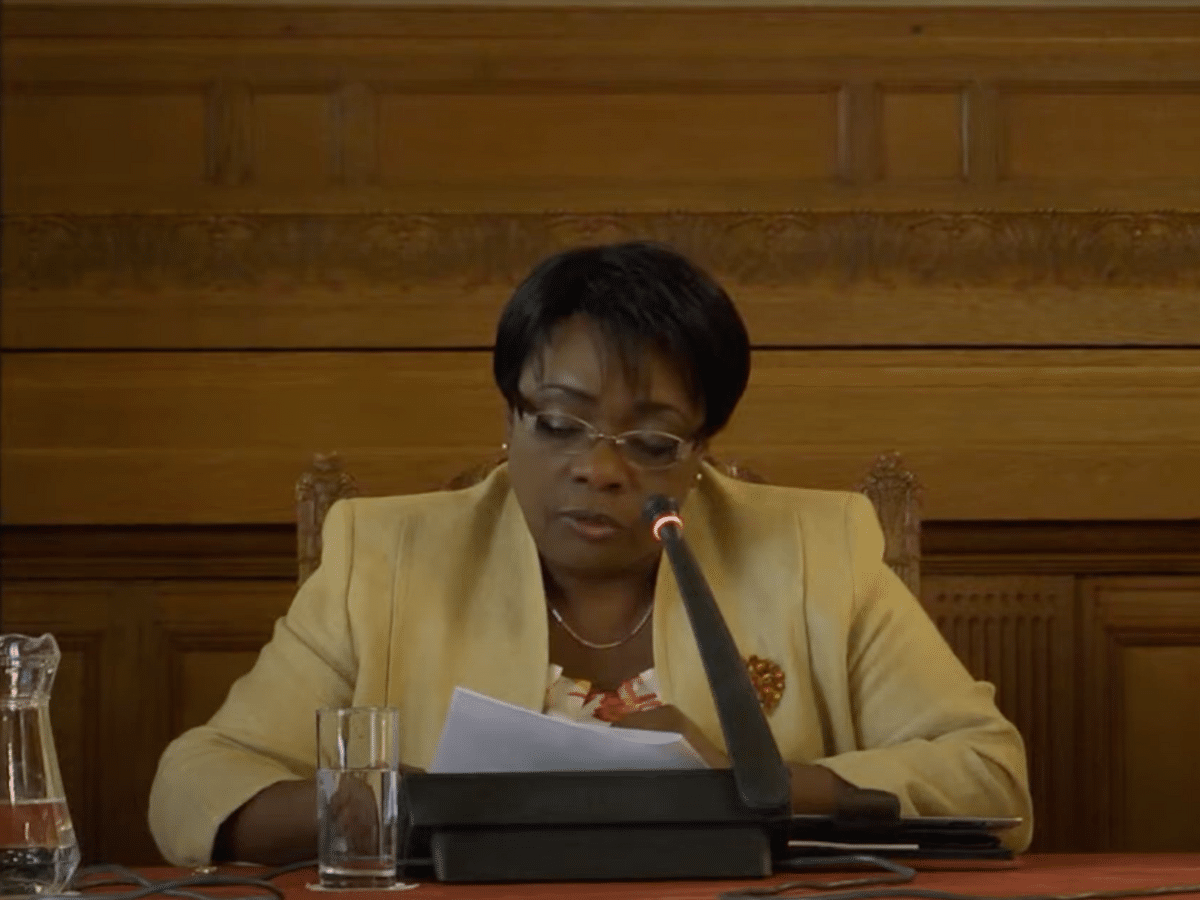
The vice-president of the International Court of Justice (ICJ), Julia Sebutinde, has faced calls to quit after making shocking remarks. The Ugandan judge told her congregation at Watoto Church that:
the Lord is counting on me to stand on the side of Israel.
The Pentecostal church was established in Kampala by Canadian missionaires, and explicitly promotes Christian Zionism.
Her statement has pushed the International Commission of Jurists to write to the president of the ICJ, Justice Yuji Iwasawa. The letter calls for an investigation into Sebutinde’s comments, and her subsequent removal from the South Africa v Israel case due to concerns over impartiality. Naturally, both Sebutinde’s comments and this letter have sparked some discussion with experts in international law. Many view the Ugandan judge’s remarks as posing a potential threat to perceptions of the Court’s independence.
However, as welcome as this attention is – to say nothing of Sebutinde’s plagiarism from Zionist sources – one central thing has been overlooked: the depth of influence of Christian Zionism in Sebutinde’s record of judgements.
ICJ’s Sebutinde: bending settler-colonial reality using the law:
Much of Sebutinde’s approach can be summed up In her dissenting opinion to the Order for Provisional Measures in the case of South Africa v Israel. Notably, she voted against all six provisional measures and, tellingly, described Israel’s ongoing settler-colonisation of Palestine as “essentially and historically a political or territorial” dispute. The conclusion she reached during this opinion was that a settlement required diplomatic negotiations, and not judicial intervention. By positioning the Zionist colonisation of Palestine as a historical, political, and ideological issue—and consequently not a violation of international law—she rehearses the discourse of Israeli permanent security. Such a logic makes Palestinians responsible for the genocidal violence inflicted upon them. This perverse framing shields Israel’s genocidal war in Gaza as lawful self-defence. And, in turn, this also sheds light on the assumptions that shape her perspective on the (il)legality of Israel’s occupation of Palestine.
Her dissenting opinion to the ICJ’s Advisory Opinion on the Legal Consequences arising from the Policies and Practices of Israel in the Occupied Palestinian Territory is an explicitly Christian Zionist manifesto masquerading as a legal opinion. Her plagiarism from Zionist sources such as the Jewish Virtual Library raises serious concerns about the materials relied upon to support her dissenting opinion. However, it is her conclusions regarding Palestinian self-determination, right to return, and illegal Israeli settlements in the Occupied Palestinian Territories that are truly shocking.
Foundation of British settler-colonialism
She condenses the multifaceted and diverse histories of Jewish life in Palestine into a “national group” established in “Ancient Israel.” She does so through employing Zionist archaeology as historical and material evidence to support biblical accounts of the presumed historical events surrounding the Israelite conquest of Canaanite lands. These “visible remains, buried in the soil” shape the ideological contours of Sebutinde’s appraisal of the past, present, and future of Israel’s settler nationhood in Palestine.
To provide her ideological perspective doctrinal support, she draws on the British Mandate for Palestine as a key source to assess the legitimacy of Israeli settler-colonialism. She provides a convoluted legal argument that designates Palestine as ‘terra nullius’ – absent of sovereign legal title. In such an interpretation, Israel would possess territorial sovereignty on all land from the Mediterranean Sea to the Jordan River.
Consequently, the Occupied Palestinian Territories become “disputed”. Through her framework, the illegal occupation becomes legal, Palestinian self-determination becomes limited to “autonomy”, and the illegal Israeli settlements in the West Bank become an assertion of Israel’s “right to settle”. Sebutinde occludes the fundamentally colonial nature of the British Mandate for Palestine and its racial regime of land settlement. In doing so, her opinion uses international law’s authority and limits of interpretation to perform a settler-colonial reality-bending exercise that renders the existence of an independent and free Palestinian nation as a breach of international law. In other words, she uses Britain’s established settler-colonial relationship to Israel to provide a legal justification for Israel’s existence that flies in the face of both reality and good legal sense.
The statehood trap of the Judeo-Christian worldview:
Sebutinde’s opinion demonstrates how the Judeo-Christian worldview still underpins international law. The widespread belief in the rationality and equality of international law means very little here.
Jamaican literary critic and theorist Sylvia Wynter articulates that the Judeo-Christian worldview emerged from Europe’s secular transformation. This transformation preserved the underlying structures and meanings of Christianity in its shift towards rational imperial civilisation. Secularity, especially in relation to international law, transposed sovereign authority over the religious authority of God. And so, it’s not actually a step too far for Sebutinde to connect a biblical “Ancient Israel” with the modern-day settler-state of Israel.
However, it’s important to keep in mind that she is not an anomaly of the legal system, but instead its logical end. As critical legal theorist Peter Fitzpatrick explains, statehood in its contemporary form still actually continues to accommodate theology as the organising principle of geopolitical relationships. The very establishment of the state of Israel relied on the foundational violence of the Nakba: a violent Judeo-Christian implementation of statehood in a very particular manner. Such a model of statehood is fraught with limitations and runs the continual risk of coercing the liberation of Palestine into the form of statehood only. Ultimately, it’s crucial that the global community doesn’t prioritise the shallow “recognition of a Palestinian State” by Euro-American states at the expense of abandoning the multitude of Palestinian freedom dreams.
Featured image via YouTube screenshot/Academy for Cultural Diplomacy